
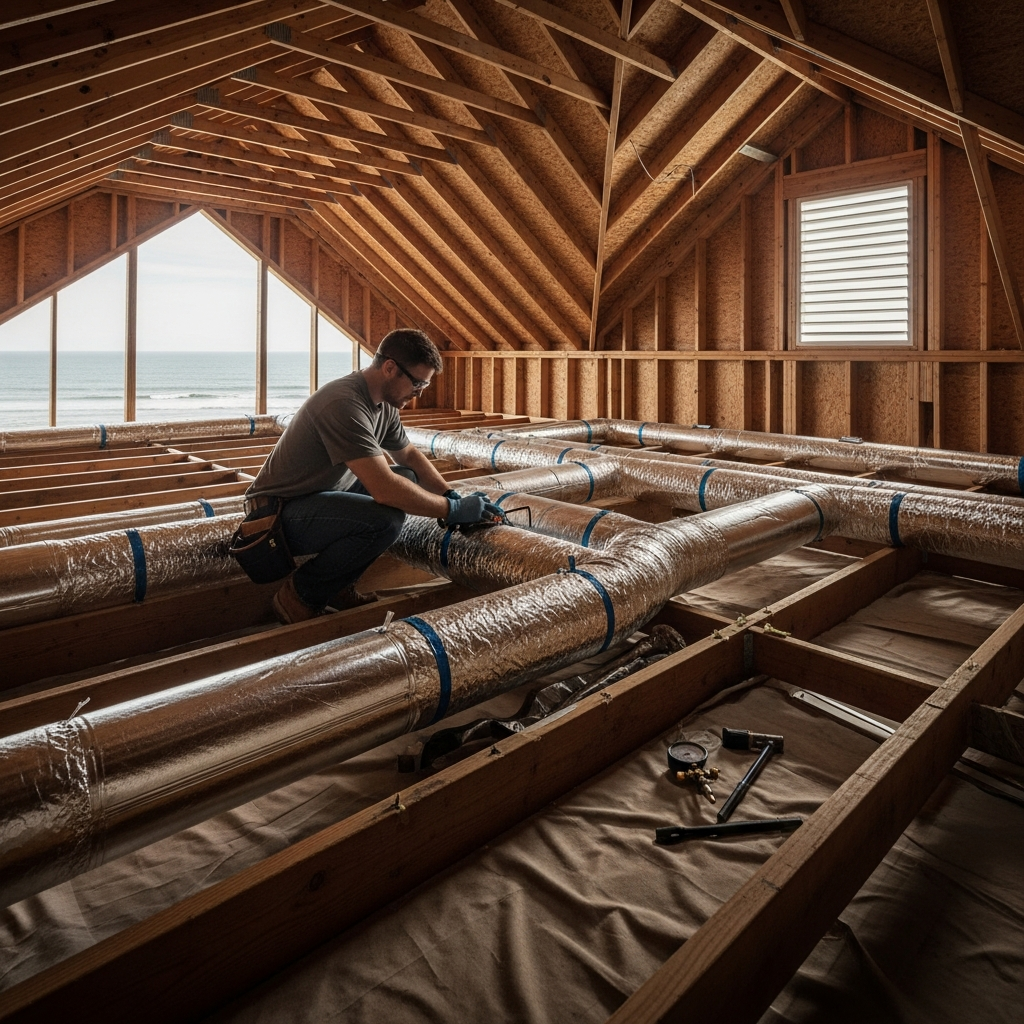
If you live in Malibu, you already know how the ocean writes its own rules for home comfort. Morning marine layer, warm afternoons, and that unmistakable salty breeze can make a house feel like a living, breathing thing that reacts to the day. It’s why homeowners here so often ask me about the real-world investment behind fixing what they can’t see—but absolutely feel—inside their walls and attics. I’m talking about the air ducts that move heating and cooling throughout the home. If you’re weighing duct replacement and trying to understand how the Malibu setting influences the total picture, this guide translates the mechanics, the climate factors, and the decision-making steps into practical terms you can use.
How Malibu’s Climate Shapes Your Decision
Malibu is not just “coastal.” It’s cliffs and canyons, sandy flats and sheltered ravines, each shaping how wind, salt air, and temperature swings reach a home. Those subtle daily shifts matter because ducts often live in attics or crawlspaces that experience extremes far beyond your living room. Attics can run hot and dry by afternoon, then cool sharply as the breeze turns, while crawlspaces collect dampness that ebbs and flows with tides and fog. Over time, that cycle can harden flexible duct jackets, corrode unprotected metal, and weaken seals. So, when locals weigh the total investment of new ductwork, they’re really choosing materials and methods that will survive in a uniquely dynamic environment.
The True Scope Behind “Replacement”
Many people hear “duct replacement” and picture a few new runs and a brighter layer of insulation in the attic. In practice, it can be much more than that. A thoughtful project looks not just at ducts, but at the supply and return balance, the air handler connections, the plenum design, the size and placement of registers, the type and thickness of insulation, and the sealing strategy used at each joint. It also includes considerations for code compliance, testing, and documentation. In Malibu, where houses range from compact beach bungalows to multi-level hillside estates with split systems and mechanical closets scattered across floors, that scope can change significantly from one property to another.
Materials and Methods Suited to the Coast
Choosing materials that respect the salt-heavy air is central to long-term durability here. Where exposed metal might see surface oxidation, protected components and corrosion-resistant fasteners hold their shape and seal better over time. Where attics are shallow or set beneath low-slope roofs, flexible ducts require extra attention to routing, stretch, and support to avoid a tangle of bends that creates unnecessary resistance. In crawlspaces where moisture is a factor, vapor barriers and proper elevation keep duct jackets dry and protect insulation from absorbing dampness. The right mastics and foils stand up to Malibu’s temperature swings and daily humidity changes; the wrong ones grow brittle and surrender at the seams.
Design First, Then Install
It’s common to focus on what ducts are made of, but the bigger lever for comfort and efficiency is how they are designed. Malibu homes often have rooms with panoramic glazing and asymmetric solar gain; others have thick shade and cool concrete below. A duct system that treats each room as if it receives the same sunshine, wind exposure, and occupancy will feel uneven to live in. Careful design begins with understanding the home’s layout, insulation, and airflow paths. The sizing of each run, the type of register, and the balance of supply to return should be mapped to the home as it exists now, not as it was decades ago when many original ducts were first installed. When design leads and installation follows, you feel the difference every day.
Air Quality and Sealing
Beyond temperature, the duct system is part of your home’s lungs. If return ducts leak in a dusty attic, you’ll breathe that dust. If supply ducts leak in a hot crawlspace, you’ll lose conditioned air into a place you will never enjoy. Malibu’s coastal air adds another wrinkle: salty particulates and marine moisture. Tight sealing with proven mastics, proper mechanical connections, and attention to boots and cans at the ceiling make a measurable difference. Post-installation testing is the reality check that confirms the results match the plan. For many clients, the first week after a well-sealed system goes live is the revelation: fewer hot and cold spots, cleaner indoor air, and quieter operation.
Access Challenges in Malibu Homes
Every Malibu project teaches humility about access. Some homes hide ducts behind finished soffits or squeeze them through knee walls barely wide enough for a hand, let alone a technician. Others have long, elevated runs crossing garages or mechanical space that once served a different layout. Planning for access—selective demo, temporary platforms, safe attic walkways, and protected staging areas—keeps the work efficient and preserves the home’s finishes. Good contractors choreograph these moves like a dance: know where to enter, how to protect, and when to rebuild. You don’t feel that planning in your living room later, but you’ll be grateful for it when the job leaves no trace.
Noise, Comfort, and Aesthetics
A well-designed system respects aesthetics as much as airflow. Malibu living is open-plan living, with sightlines and ceiling planes meant to disappear. That means registers and grilles should be selected and placed to complement the room, not to shout at it. Noise is equally part of the aesthetic experience; high-velocity air squeezed through undersized registers or tight bends becomes a hiss you’ll learn to resent. Gentle transitions, proper diffuser selection, and correct sizing reduce that whoosh into a whisper. The payoff isn’t something you point to on a blueprint; it’s the way conversations sound in the evening after the marine layer slides in and the system ramps gently to keep everyone comfortable.
Permits, Inspections, and Documentation
In California, ducts are not a “just swap it out” item. Proper permitting and compliance testing are part of a complete job. That means planning for the timeline and the checkpoints: application, rough-in inspections where relevant, final verification, and any performance testing required. Malibu’s unique geography sometimes layers coastal wind zones and wildfire exposure requirements over the base code, which can influence material choices or placement for exterior penetrations. The paperwork may not be glorious, but it protects you in the long run by creating a clean record of what was done, how it was verified, and that it met the standards in place at the time.
What Affects the Overall Investment
People often ask what drives the investment up or down in our area. It comes down to a constellation of details: the size and layout of the home; access to attics and crawlspaces; whether the project includes design revisions or merely like-for-like replacement; the condition of existing registers and boots; the choice of insulation and jacket type; the extent of sealing and testing; and the permitting pathway. The coastal setting adds the variable of corrosion resistance and moisture strategy. Even the calendar can matter: scheduling around major holidays or marine layer seasons changes how long attic work is comfortable and efficient.
The Day-to-Day During a Project
When we start a project in Malibu, we begin by walking the space with the homeowner and confirming protection plans for floors, furnishings, and pathways. Attic and crawlspace entries get zippered barriers, and staging areas are clearly marked to keep dust and debris contained. Duct removal follows a methodical sequence: cap and protect open equipment, isolate returns, and remove in pieces so existing insulation and finishes are not disturbed. Installation is a reverse choreography with new materials set gently along planned routes, supported to maintain shape, sealed meticulously, and labeled for future service. Before the system is commissioned, we test the ductwork and address even small anomalies so the final adjustments are minor and precise.
Longevity, Maintenance, and Peace of Mind
The best time to think about maintenance is before the first new run is hung. Malibu homeowners benefit from ducts that are both tough and thoughtfully placed for future service. Clear, stable supports prevent sagging and chafing, while straighter runs make inspection simple. Registers that can be easily removed encourage periodic cleaning. Sealed and insulated connections keep energy where it belongs and prevent condensation from ever taking hold. These small design decisions pay back every summer when the fog lifts and your system quietly keeps pace without strain.
Energy Efficiency in a Coastal Microclimate
Efficiency is not just a number on a spec sheet—it’s the feeling of a system that rarely has to work hard to make the home feel right. Malibu’s microclimate changes the equation hour by hour; efficient ducts keep you closer to the comfort line with fewer long cycles. Thoughtful returns reduce pressure imbalance between rooms, and quality sealing means the air you paid to condition actually reaches the living space. Pair that with modern controls and you get a home that adapts as the sea breeze shifts. Many homeowners notice that with proper duct design and installation, the system’s behavior is calmer; the home feels more even, and that steadiness is its own kind of luxury.
Mid-Project Questions Homeowners Often Ask
About halfway through a project, it’s normal to feel curious about what’s happening out of sight. Homeowners ask if the new runs will reach that stubborn corner bedroom, whether a particular grille can be more discreet, or how the final sealing will be verified. This is where open communication matters. A good team will show you pictures from the attic, explain the transitions and supports, and review testing targets in everyday language. And if a mid-course refinement is wise, it can be incorporated without losing momentum. Your role is to ask freely; our role is to translate duct language back into daily-life comfort. If at any point you want more clarity, remember that exploring local duct replacement services in context of your home’s unique layout is not just appropriate—it’s essential.
Timing and Seasons
In a place defined by the ocean, timing makes a quiet difference. Attic work is more pleasant and often more efficient during cooler morning hours before the afternoon warms the roof deck. Winter’s calmer weather windows can be ideal for certain homes, while late spring often brings schedules that must weave around school calendars and holidays. The key is to plan with your team and leave a little flex for coastal weather. The payoff is a process that feels orderly and respectful of your life at home.
What Success Feels Like
You know a duct project succeeded not when you look at the photos from the attic, but when the house simply “disappears” under you in the best way. Temperatures hold room to room. The system cycles gently. Conversations are easy, and the home seems to breathe more quietly. That’s what the Malibu climate asks of us: not brute force, but harmony. It’s the slow, steady confidence that the air will be the right temperature whether the surf is booming or the canyon winds pick up after sunset.
Common Misconceptions
Many believe that ducts are a commodity, that any run that moves air is good enough. In reality, the shape, length, and sealing of a duct can be the difference between a comfortable home and one that never feels settled. Another misconception is that what you can’t see won’t matter. But because ducts often sit outside the thermal envelope, small flaws compound quickly. In coastal zones, assuming “the weather is mild, so the system isn’t working that hard” can also mislead. Humidity, fog, and salt are their own kinds of tests, and durable design is what meets them day after day.
Working With a Local Team
Malibu is a small town with global tastes. Projects often aim for invisibility: clean ceilings, quiet rooms, and sunsets that are the star. A local team understands that choreography, the rhythm of permitting, and the microclimate nuances between Broad Beach and Corral Canyon. They’ve learned how to protect finishes during access, how to talk with neighbors when staging on narrow roads, and how to keep sand and salt where they belong—outside. More than anything, they know that comfort here is a feeling as much as a measurement.
FAQ
How do I know my home truly needs new ducts? You might notice rooms that never match the set temperature, a system that runs longer than it should, visible kinks or damage in accessible flex, or dust streaks at registers. A thorough inspection and airflow testing tell the real story and can confirm whether repair, redesign, or full replacement delivers the best outcome.
Will new ducts make the system quieter? Yes, when design and installation are done well. Correct sizing, smoother transitions, and the right diffusers reduce turbulence and hiss, creating a calmer sound profile throughout the home.
What role does sealing play? Sealing is everything in a climate like Malibu’s. Proper mastics and mechanically secure joints keep conditioned air inside the ducts and prevent dusty or salty air from entering on the return side. It’s often the biggest single improvement in day-to-day comfort.
Can ducts improve indoor air quality? A well-sealed, well-balanced system reduces the pathways for attic or crawlspace particulates to enter your living space. Pairing that with correct filtration at the air handler supports better indoor air quality overall.
What about permits and inspections? Expect a defined process with documentation and testing. A reputable contractor will guide you through the steps, schedule inspections, and provide final verification so your records are complete.
How long does a typical project take? It depends on the home’s size, access, and scope. Local teams will stage thoughtfully, protect finishes, and coordinate inspections to keep the timeline predictable while leaving room for Malibu’s weather.
What maintenance should I plan for after installation? Simple, regular filter changes and periodic visual checks at registers go a long way. Your contractor may also recommend routine inspections to confirm supports are secure, insulation is intact, and seals remain tight.
Ready for a More Comfortable Malibu Home?
If you’re ready to talk through options tailored to your property, we’re here to walk the attic, crawl the tight spaces, and explain the plan in plain language. Start the conversation today and discover how thoughtfully designed and installed ducts can transform daily life by the coast. For guidance aligned with Malibu’s unique climate and architecture, reach out about duct replacement and let’s chart the right path together.