
Most Malibu homeowners first suspect duct problems not by peering into an attic, but by how their homes feel day to day. Maybe the living room warms up in the late afternoon no matter how low the thermostat is set, or a bedroom never seems to catch up on chilly mornings. Sometimes it’s a sound—a rush or whistle at a register—or a smell that hints at dusty crawlspaces or salt-laden air. If you’re noticing patterns like these, it may be time to evaluate whether your distribution network is due for a thoughtful refresh. If you’re early in the learning curve, start by understanding what modern duct replacement can solve, and how to tell the difference between a quick fix and a deeper issue.
Because Malibu homes span beach bungalows, hillside retreats, and expansive estates, the signs that point toward replacement vary widely. Yet they often trace back to a few root causes: leakage, poor layout, deteriorated insulation, or return pathways that never matched the home’s actual needs. The coastal setting adds its own twists, with salt air, wind, and marine layer cycles subtly aging materials and exposing the weak links in long runs or improvised remodel-era transitions. The good news is that a careful inspection and a bit of testing can reveal where performance is being lost—and what kind of project will restore comfort and cleanliness.
Uneven rooms and shifting comfort
Persistent hot and cold spots rank high among the everyday clues. If the den near the deck regularly overheats in afternoon sun while interior rooms feel fine, that suggests a distribution imbalance rather than a thermostat issue. Duct replacement driven by design—not just swapping parts—lets you right-size runs, add returns where needed, and reroute to reduce resistance. The result is steadier temperatures from sunrise to sunset, especially in spaces with big glass exposures facing the ocean breeze.
Look for patterns. Does a specific room lag behind every morning? Does a door need to be left open to stay comfortable? Those habits indicate the system is fighting itself. While a single crushed run can sometimes be repaired, widespread unevenness often signals bigger layout or leakage issues that replacement addresses more effectively.
Airflow noise and register hiss
Sound can be as telling as temperature. Whistling or hissing at certain grilles typically means air is being forced through a constriction—sharp elbows, undersized last-foot transitions, or registers that don’t suit the room. A redesign softens those bottlenecks with smoother trunks, generous bends, and better grille selection. When resistance drops, equipment can run at quieter speeds, which you notice most at night when the house is still.
Occasional noise is normal when a system ramps up, but constant rush or whine is a clue that the network is too tight for the job. Replacement solves that, while patching one or two spots may leave similar restrictions lurking elsewhere.
Odors, dust, and indoor air quality
Musty, dusty, or outdoorsy scents drifting from registers suggest that unconditioned air is joining the airstream through gaps. Malibu’s coastal winds can pressurize certain sides of a home, pulling attic or crawlspace air into leaky ducts. Sealing leaks helps, but when gaps are widespread or insulation is degraded, a comprehensive replacement with robust sealing and continuous insulation pays off in cleaner indoor air. During wildfire season, that same tightness helps reduce particulate intrusion, especially when paired with filtration matched to both airflow and household needs.
Consider how often you’re dusting or whether you notice fine particles on surfaces despite keeping windows closed. Those signs point to leakage and poor return strategies that invite everything from attic fibers to outdoor particulates into circulation. Replacement addresses root causes rather than chasing symptoms with constant filter changes.
Humidity swings, condensation, and coastal realities
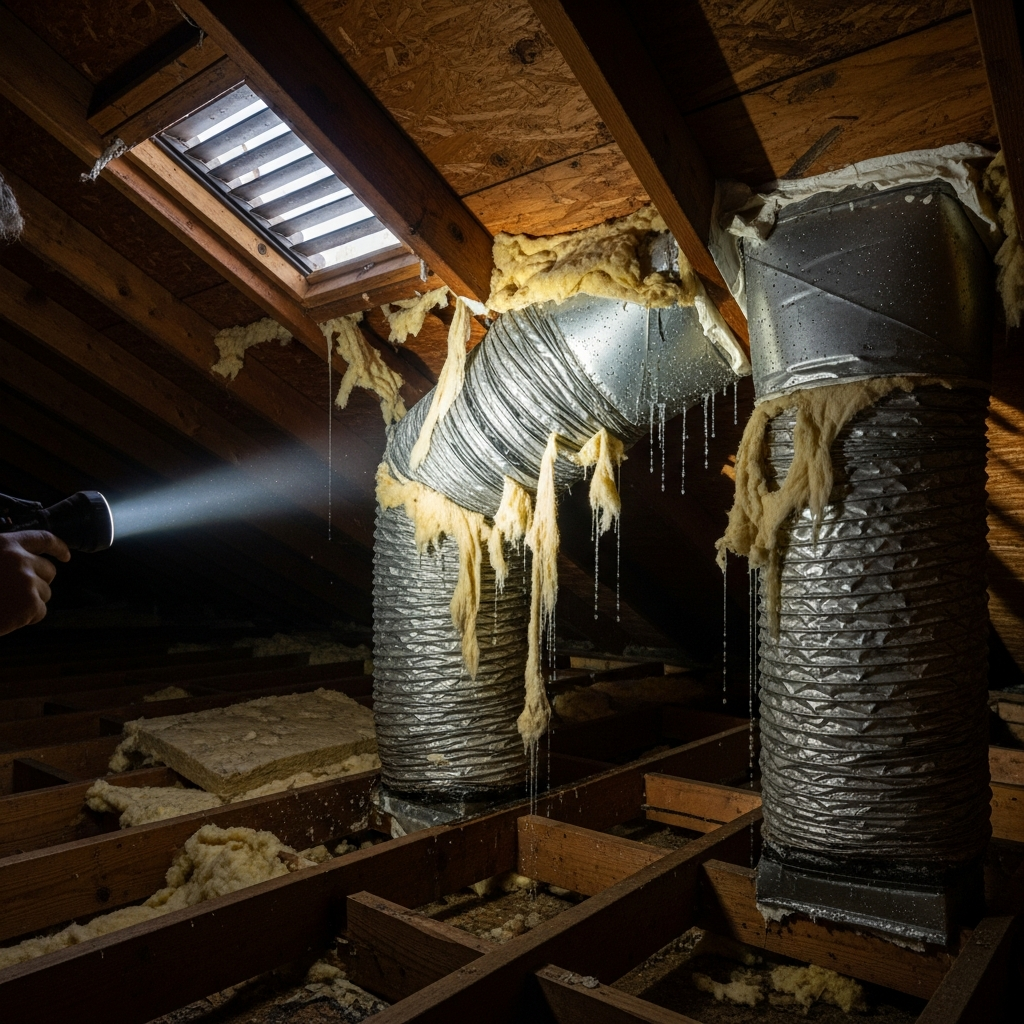
Marine layer mornings and cool nights create conditions where unprotected metal can sweat. If you’ve spotted dampness around boots or felt clammy air near certain runs, condensation may be forming where insulation is thin or discontinuous. Efficient duct systems rely on uninterrupted insulation and vapor-aware details to keep surfaces dry. Replacement gives you the chance to correct those weaknesses holistically, not just at the most obvious spots.
Humidity swings affect adhesives and tapes, too. If you see dried, peeling tapes or cracked sealant in accessible areas, assume similar aging elsewhere. Modern mastics and mechanical fasteners withstand coastal cycles better, keeping connections tight over time.
Visible wear, kinks, or improvised transitions
Not all evidence is hidden. Crushed flex, sharp turns crammed into tight soffits, or long unsupported spans all hurt performance. If you see insulation jackets torn or sagging, or if transitions into registers look improvised, those details add up to a system that forces your equipment to work harder while delivering less comfort. A replacement guided by design smooths those paths, supports runs correctly, and eliminates the fragile patches that tend to fail at the worst time—usually when you need the system most.
Homes that have evolved through multiple remodels often reveal patchwork distribution: an added room fed by an overextended branch, or a return that never grew to match new square footage. Over time, these decisions erode comfort until they become hard to ignore.
Doors that must stay open to feel right
If bedrooms feel stuffy once doors are closed, it’s a sign that return pathways are undersized or poorly located. That everyday workaround—keeping doors ajar—tells you the system lacks balanced circulation. Replacement provides the opportunity to reimagine returns so each area breathes properly, improving comfort and privacy at once.
Balanced returns also help filtration perform as intended. Filters cannot do their job if airflow is starved. With the right design, your home maintains fresh, even conditions without forcing equipment to run loudly just to overcome bottlenecks.
Long run times and short cycling
When equipment runs for long stretches without achieving setpoints or cycles on and off frequently, the distribution network is often the culprit. Leaks waste the output your equipment is trying to deliver, while tight, convoluted paths restrict it. Replacement that aims for low resistance and tight sealing lets equipment settle into an efficient rhythm, improving both comfort and everyday peace and quiet.
Malibu’s sun can be intense on west-facing rooms, and without a distribution plan that anticipates those afternoon loads, systems tend to overwork at precisely the time you want them to be most unobtrusive. A redesigned network helps the equipment keep pace smoothly rather than lurching into loud, high-speed operation.
Testing: the truth serum for distribution problems
The surest way to determine whether you need repair or replacement is to test. Duct leakage testing quantifies losses, while pressure and airflow measurements show where restrictions live. Good contractors pair this data with a visual inspection and a conversation about how your home feels across the day. That combination reveals whether surgical repairs will deliver the comfort you want or whether a clean-slate redesign will be more effective and durable.
Testing also sets a baseline for success. After work is complete, repeating the measurements verifies that improvements are real. It’s one thing to hope for better comfort; it’s another to see it documented and then feel it in everyday living.
Frequently Asked Questions
Can I fix just the worst runs and call it good? Sometimes, yes—if tests show the rest of the system is sound. But if leakage and restrictions are widespread, piecemeal fixes rarely deliver lasting comfort. A design-led replacement corrects root causes.
Will new ducts make my home quieter? Typically, yes. Smoother trunks, better last-foot transitions, and balanced returns allow lower fan speeds and reduce hiss or whistle at registers, especially noticeable at night.
How do coastal conditions change the plan? Salt air and humidity cycles stress materials and adhesives. Replacement that emphasizes robust sealing, proper supports, and insulation continuity stands up better along the coast.
What about odors or dust that appear during windy days? Those are classic signs of infiltration through gaps. Tightening the distribution network and aligning returns with filtration strategies reduces the entry of particulates from attics or crawlspaces.
Is permitting part of this work? Yes, expect permits, inspections, and testing. These steps protect you by ensuring hidden components meet modern standards for safety and performance.
How disruptive is the process? With a clear sequence and daily communication, crews can protect finishes, manage dust, and phase work to keep parts of the system usable. Most homeowners find the routine manageable when expectations are set up front.
Take action with confidence
If the patterns in your home—uneven rooms, persistent noise, or telltale odors—sound familiar, it may be time to look beyond quick fixes. A thoughtfully designed project will align the distribution network with Malibu’s microclimates and your daily routine, delivering calmer, cleaner, more even comfort. When you are ready to explore duct replacement with a local expert, reach out for a consultation that begins with testing and ends with a system you hardly notice because it simply works.