
Ask ten people in Malibu what they think about “per square foot” estimates for duct work and you’ll likely hear ten different stories. On paper, simplifying a project to dollars per square foot sounds tidy, but in our coastal hills and beachfront neighborhoods, ducts do not care about tidy math. They care about space, friction, pressure, and access. If you’ve ever opened a low-slope attic only to discover a maze of trusses and electrical runs, you already know why a simple area-based number can mislead. The better approach is to treat square footage as a starting reference while leaning hard on design, accessibility, and craftsmanship to predict scope. As you dive into this topic, it helps to ground yourself in a clear explanation of duct replacement so you can translate general guidance into choices that fit Malibu’s unique housing stock.
Let’s start with the misconception. Floor area does not equal duct difficulty. Two homes with identical square footage may be opposites in distribution complexity. One might have a roomy, walkable attic, straight shot trunks, and short branches to compact rooms; the other might have cathedral ceilings, a flat roof with no chase space, and long meanders to glassy additions at the ocean side. The first home invites efficiency; the second demands creativity and time. So when you hear a “per square foot” figure, recognize that it compresses all those realities into a single average that may or may not fit your project.
Why square footage falls short in Malibu
Our city’s topography drives architecture, and architecture drives mechanical pathways. Hillside properties often rely on split levels or staggered volumes that complicate trunk alignments. Beach homes push equipment to cramped corners where noise control and short, efficient runs become a puzzle. Add salt air to the equation and you need insulation jackets and sealing methods that hold up to morning moisture. Each of these variables increases or reduces labor, materials, and testing—not because of the area of your floors, but because of the three-dimensional chess inside your walls and ceilings.
There’s also the simple matter of return air. Malibu homes are frequently under-returned, especially if they were remodeled over time without updating the distribution system. Adding or relocating returns to quiet the system and balance airflow can transform comfort, yet this work is invisible to a square-foot formula. So is the strategic use of sheet metal trunks for low-noise performance, or the choice to route ducts within conditioned space where feasible to reduce heat gain or loss.
Translating area into airflow
To do per-square-foot math properly, you need to convert floor area into room-by-room loads, then translate loads into required airflow, then translate airflow into duct sizes and lengths that fit the structure. That chain of logic is the backbone of design. Manual J gives you the loads; Manual D maps those loads to ductwork; careful fieldwork then adapts the map to your home’s obstacles. When you treat square footage as a proxy for airflow without following the steps, you end up with oversized or undersized branches, velocity issues, and uneven rooms. Those corrections later are what inflate projects far more than the materials themselves.
In practice, I like to start with the rooms that define the home’s comfort story. Is there a glass-walled living room facing the water, a bedroom over a garage that runs cold, or a loft that traps heat above the kitchen? Targeted design for these spaces often sets the trunk strategy for everything else. Suddenly, the “per square foot” conversation becomes a nuanced plan for how to move air quietly and efficiently through the home you actually live in.
Access tells the real tale
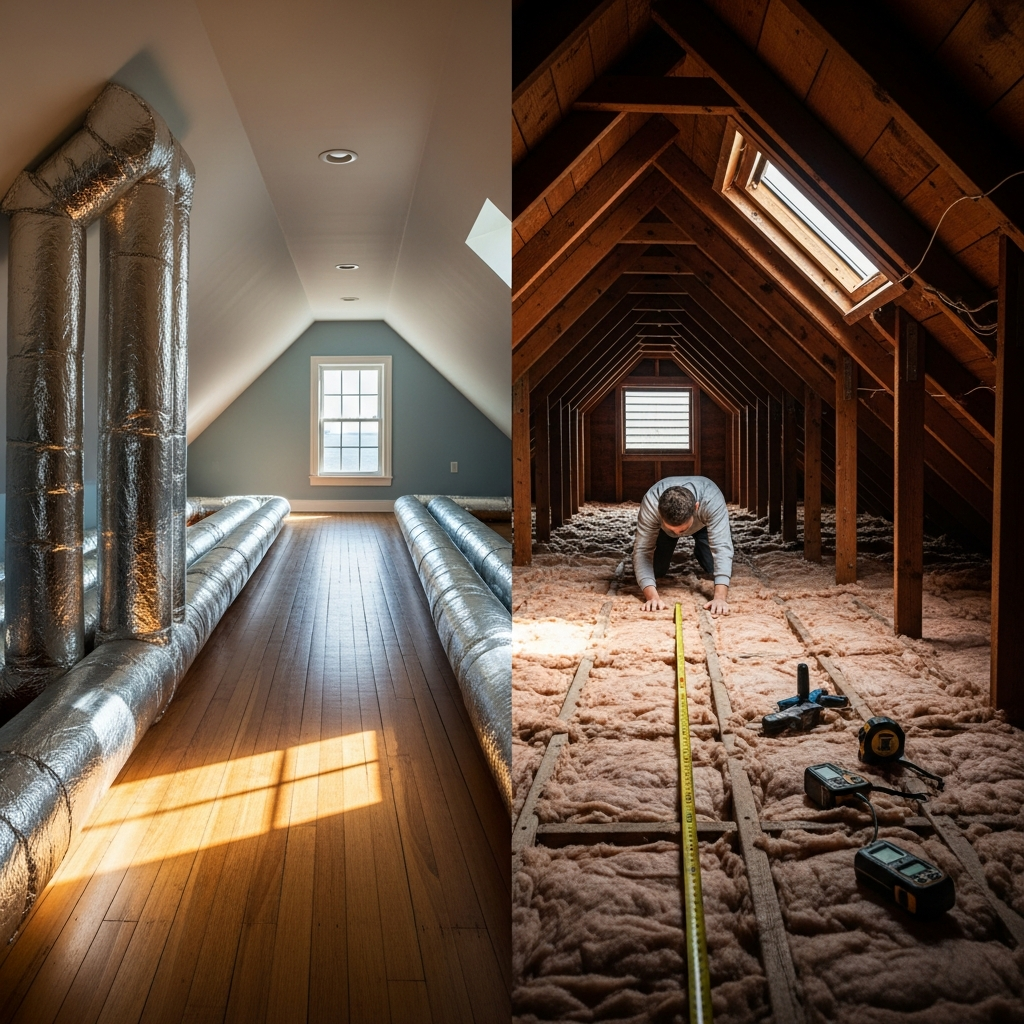
No factor whips per-square-foot math more than access. If your attic allows workers to stand and move freely, runs can be routed, hung, and sealed with precision and speed. If your attic requires belly-crawling beneath truss webs, with every hanger prefabricated and slid into place one by one, the same number of linear feet becomes a very different task. Crawlspace work comes with its own choreography: protecting soil from disturbance, controlling moisture, and routing supports so ducts don’t rest on edges or sag over time. Each constraint adds time to do things correctly; doing them sloppily might be faster in the moment, but it never pays off in performance.
During replacements tied to renovations, we sometimes have the luxury of open ceilings. Those are the moments when even complex Malibu homes briefly behave like new construction. Duct routes can be straightened, returns placed perfectly, and insulation applied with consistency. If you’re planning a remodel, coordinating timing can lower effort and disruption. Again, this is invisible to a per-square-foot figure unless the estimator truly understands your project phasing.
Material choices that interact with space
Whether you choose flex for short gentle branches, sheet metal for main trunks, or ductboard for select sections, the right material in the right place matters. In salt-tinged air, insulation jackets and vapor barriers keep systems stable across damp mornings and hot afternoons. Mastic sealing remains the gold standard for durable airtightness. Where noise is a concern—like bedrooms off narrow halls—lined returns or smooth-walled trunks can be worth the extra effort. None of these decisions align neatly with square footage; they align with how you want the home to feel when the work is complete.
Some homeowners worry that switching materials mid-run betrays quality. Done haphazardly, yes. Executed with purpose—sheet metal trunk to a plenum, then taut flex to reach a tight joist bay—it’s a smart use of each material’s strengths. The guiding principle is friction management and support: straight where you can be, broad curves where you must bend, and consistent support so ducts don’t sag into energy-wasting shapes.
Testing and verification: the great equalizer
Square footage will never tell you whether a system is airtight, but a duct leakage test will. Pressure and airflow measurements confirm that the design you paid for exists in your attic or crawlspace, not just on a proposal. Balancing dampers, if used, should be set with intent and recorded. Room-by-room results can then be compared to targets. This is how we transform a conceptual “per square foot” conversation into real comfort under your roof. In California, verifying leakage and insulation levels is standard practice and improves outcomes regardless of home size.
Midway through many projects, homeowners ask whether it makes sense to upgrade returns, quiet a noisy run, or prepare for better filtration ahead of wildfire season. Those are great moments to check back against a primer on duct replacement so additions align with core design and don’t become bolt-ons that complicate balance. Each upgrade should have a reason and a measurable benefit you can feel or verify.
Special Malibu considerations that break the mold
Our neighborhoods each have their quirks. Broad beachside rooms ask for gentle, evenly distributed supplies that wash glazing without drafts. Canyon homes often need returns placed where stratified air can be pulled down and mixed. Many houses, especially those with multiple remodels, suffer from “duct archaeology”—a trunk that once served a removed wall or a branch that makes three unnecessary turns to dodge a long-gone soffit. Replacements are your chance to erase history that no longer serves your comfort.
Salt exposure recommends hardware choices that don’t fail early: corrosion-resistant hangers, jackets with strong outer scrims, and sealants that don’t peel under dew cycles. Steep driveways, limited staging, and noise regulations near the coast or in the hills also nudge scheduling and logistics. None of this is captured by square footage, yet all of it lives in the real calculus of scope.
How to interview contractors beyond “How much per foot?”
Ask how they will size and balance the system. Request a simple sketch of trunks and branches with airflow targets. Discuss how they’ll protect finishes, manage debris, and coordinate inspections. Clarify what testing you’ll receive and what results look like for a successful job. If an estimator can answer these questions clearly, their number—whatever its format—likely reflects a thoughtful plan. If not, a per-square-foot quote is just a placeholder waiting for surprises.
FAQ: Per-square-foot duct work questions
Can per-square-foot estimates ever be accurate? They can be ballpark useful in straightforward homes with accessible attics and simple runs. But Malibu’s variety means detailed design and access planning produce far better predictions.
Is a flat roof a dealbreaker for efficient duct layout? Not at all, but it narrows options. You may rely on soffits, interior chases, or careful routing within conditioned space. The design will be custom to your structure.
Will larger ducts guarantee better comfort? Larger isn’t automatically better. You need the right size for the airflow target and available pressure. Oversized branches can reduce throw and leave distant rooms underserved.
How do returns affect the project? Returns are the lungs of the system. Adding or resizing them can transform noise levels and balance. Expect that return work might be the best “square foot–defying” upgrade you make.
What tests should I expect after installation? Duct leakage testing, static pressure measurements, and room airflow checks are standard. They verify that design goals survived real-world installation.
Will new ducts help during wildfire smoke events? Yes, when coupled with upgraded filtration and tight duct sealing. Keeping leakage low prevents attic particulates from entering your living space.
How do I time this with a remodel? If ceilings will be open, coordinate schedules so duct routing can be optimized. That window can reduce effort and disruption significantly.
In the end, square footage is the cover of the book, not the story. Malibu homes deserve distribution systems written for their chapters—ocean, canyon, glass, tile, and family routines that define comfort. If you want a reliable reference as you compare proposals, keep a clear guide to duct replacement at your side and insist that any number you receive follows from a believable plan. When you’re ready to feel the difference in every room, invite a local pro to walk your attic or crawlspace and talk through the path of air. Schedule a visit today and take the first step toward quieter, more even comfort with expert duct replacement tailored to Malibu living.