
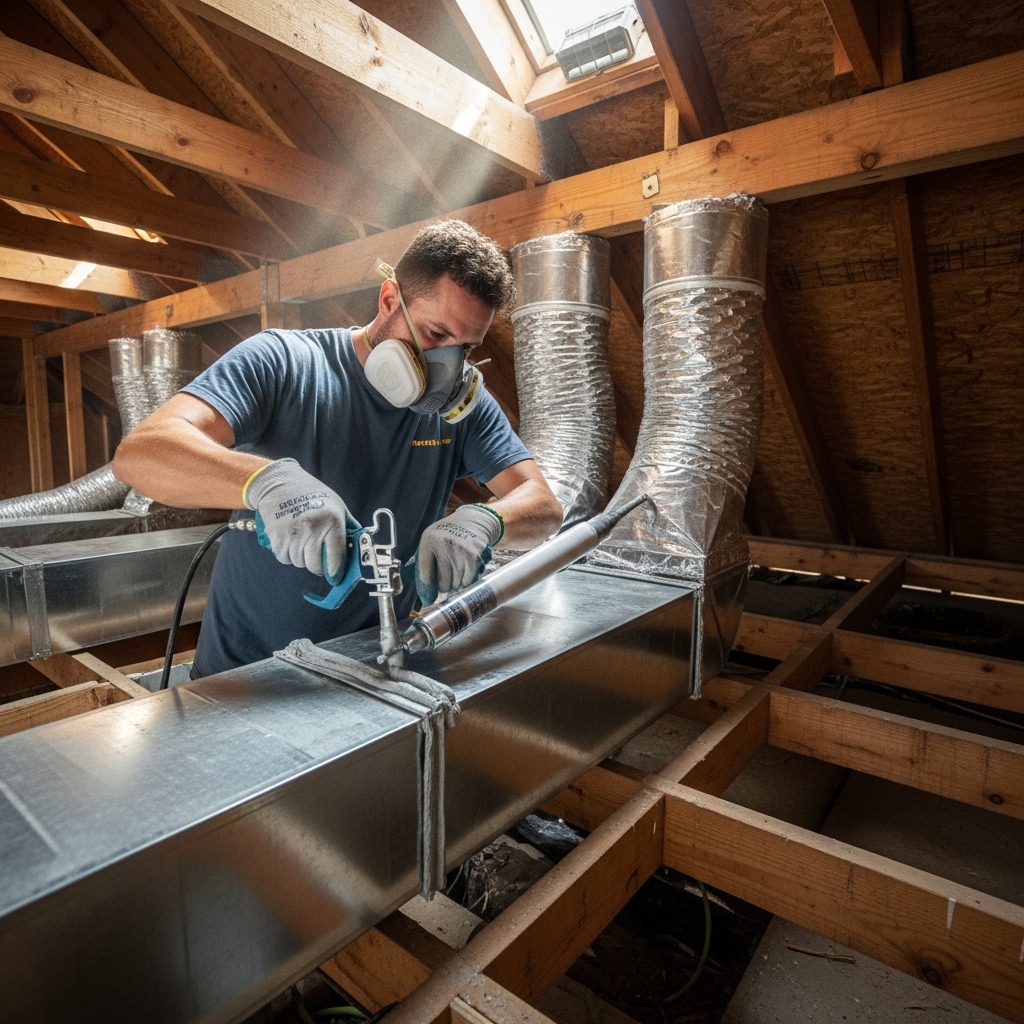
Ask ten Malibu homeowners what they want to know about duct work and most will say the same thing: “What’s the cost per square foot?” It is a fair question, especially when you are trying to compare projects or sketch out a rough budget. Yet in our coastal hills and canyons, where homes cling to slopes, perch above the surf, or tuck into quiet ravines, a strict per-square-foot figure rarely tells the full story. Malibu’s architecture and microclimates introduce variables that directly affect the scope, complexity, and timeline of any duct replacement job. The length of the ductwork is only one piece; access, materials, existing conditions, and performance objectives weave together to shape the actual effort required. Understanding those layers will help you plan more confidently and end up with a system that truly suits your home.
Think of ducting like the circulatory system of your house. The routing, the elevation changes, the hidden obstacles, and the way air has to move through rooms of wildly different exposures all influence how that system needs to be rebuilt. A per-square-foot number might suggest that a two-thousand-square-foot home requires twice the investment of a one-thousand-square-foot home, but Malibu’s reality often flips that assumption. A compact beach cottage with a low crawlspace can present tighter, more time-consuming access than a spacious ridge-top residence with a clean, open attic. In other words, the tape measure is less important than the path the air must travel.
Why “per square foot” is slippery in Malibu
Our terrain and construction styles are delightfully eclectic. You will find 1970s ranch homes with long, meandering attics, mid-century gems nestled into slopes with duct runs weaving across split levels, and newer architectural showpieces with extensive glazing and high ceilings. Each home asks for a duct layout that respects its bones. When people ask for cost per square foot, they are often hoping for a universal yardstick, but the things that truly drive project effort—access points, framing, existing insulation, previous duct routing, and the desired performance outcomes—do not scale linearly with house size.
Consider two houses of similar square footage. One sits on a flat lot with a roomy, walkable attic and a straightforward trunk-and-branch layout. The other sits on a hillside with multiple half-levels, exposed beams, and limited attic space, where a portion of the ductwork must travel through chases and conditioned soffits. The hillside house might require more careful redesign and labor even though the square footage is identical. Malibu has more than its fair share of those hillside quirks, and that fact alone explains why per-square-foot expectations often clash with reality.
There is also the matter of what you are trying to fix. Some homeowners pursue a one-to-one swap—old for new along the same paths—while others are correcting long-standing comfort issues, balancing rooms, quieting a roaring return, or preparing for improved equipment. The deeper the performance goals, the more thoughtful the redesign. The per-square-foot notion tends to ignore the value of that thinking time, even though design attention is what separates “new ducts” from “new ducts that make the home feel and sound better.”
Access is destiny
In Malibu, the quality of access often decides how a project will unfold. Attics with low clearances, bracing, or obstructions slow work and may limit the diameter and routing options. Crawlspaces can be sandy, tight, or interrupted by piers in stilted beach homes. Some residences rely on concealed chases or interstitial spaces above architectural ceilings. Access defines not just how fast a crew can move but whether certain materials or fittings are feasible, and it guides whether a segment should be rerouted for longevity and performance. The constraint is more than comfort for the installer; it shapes the system itself.
When we evaluate a home, we look for pinch points like narrow eaves, truss webs, nonstandard framing, and crowded mechanical areas. We assess the condition of existing ducts, hangers, mastic, and insulation. We check for prior workarounds that might have made sense during a remodel but now add turns or restrictive transitions. Every added elbow, every kinked run, every long detour introduces resistance and saps airflow. The goal of replacement is not only to refresh materials but to rationalize the pathway so that the equipment can do its job without strain.
Materials and methods shape outcomes
Another reason per-square-foot thinking falls short is that it reduces nuanced material choices to a single thumb rule. Malibu homes see salt-laden breezes, foggy mornings, and periods of intense sun. Materials must resist corrosion, maintain insulation values, and seal tightly over time. Proper mastic application, appropriately supported runs, and carefully sealed connections make a remarkable difference in delivered airflow and long-term durability.
In practice, the best systems often blend components: a sturdy metal trunk where it matters, flex runs sized and supported to minimize sag, well-designed plenums and transitions, and meticulous sealing at boots and registers. The craft shows in the details—how a radius elbow replaces a sharp turn, how a return drop is sized to quiet a whine, how a branch is shortened to feed a starved room. Those refinements cannot be captured by a coarse square-foot figure, yet they pay back daily in comfort and efficiency.
Design for Malibu’s microclimates
Few places cram so many microclimates into a narrow band as Malibu does. Onshore breezes temper afternoons near the water but leave marine layers clinging to the mornings; canyons trap stillness and heat; ridgelines face direct sun that bakes roofing and attic spaces. Duct designs must account for these contrasts. Runs that pass through hot attics need robust insulation and minimal length. Return placement should reflect where heat builds and where occupants spend time. Supply registers need to address large windows without creating drafts. Thinking carefully about solar exposure and typical occupancy patterns helps your replacement project deliver an experience that reads as calmer, quieter, and more even from room to room.
Ventilation is part of the story as well. Malibu homes frequently benefit from thoughtful fresh-air strategies, especially in periods of wildfire smoke or when windows remain closed for long stretches. Integrating controlled ventilation paths, filtration upgrades, and balanced return strategies can transform how a home feels. These are not add-ons; they are design choices woven into duct layout. Again, this is where per-square-foot shorthand misses the point: quality of experience depends on orchestrating multiple details, not just swapping materials.
Code, testing, and performance verification
Our region expects duct systems to meet energy and sealing standards, and that is a good thing for homeowners. Proper sealing, adequate insulation, and verifiable leakage control translate directly into comfort and lower energy waste. Replacement projects should end with measurable improvement—tighter connections, stable static pressures, balanced airflow, and quieter operation. The process of testing and tuning is part of the craft. It also adds certainty that the design you paid for is the design you got, not just an approximation.
Performance verification is especially meaningful in homes with long runs or complex routing. The more twists and turns, the more opportunity for loss. Measuring delivered airflow, temperature split, and system pressures confirms that each room receives what it needs. When a project incorporates these checks, homeowners notice the difference right away: fewer hot and cold spots, calmer background sound, and equipment that cycles less aggressively.
How scope evolves during evaluation
Homeowners often begin by imagining a like-for-like swap, only to discover that their comfort complaints stem from layout missteps that date back decades. Perhaps a bedroom was starved for air, a return was undersized, or a branch was routed the long way around an obstruction. With the attic open and old materials removed, it is the perfect moment to correct those inherited problems. That is why site visits and careful design conversations matter. The work expands to include solutions that make the home feel right, rather than just making the ducts new.
Even the little choices add up. Simple changes—like relocating a boot a few inches for better throw, substituting a radius fitting for a tight elbow, or right-sizing a return—improve airflow and reduce noise. The result is more restful bedrooms, a quieter family room, and a kitchen that does not feel starved of conditioned air during gatherings. Measured by surface area alone, these upgrades disappear in a spreadsheet. Measured by lived experience, they are the difference between “it’s fine” and “this is how it should have felt all along.”
Middle-of-project realities
Once work begins, crews navigate the realities hidden above the ceiling. Some runs prove longer than expected; others reveal pinch points that call for rerouting. Access panels may be added to ease future service, or chases may be built to conceal essential paths in architectural homes without traditional attics. This is the moment where a team’s experience in Malibu pays off. We have learned how to protect finishes, coordinate with other trades on active remodels, and keep project momentum even when the structure throws surprises our way. If your goal is a durable, quiet system, that patience and problem-solving become worth more than any simplistic per-square-foot estimate.
If you are comparing proposals, ask how the layout will change to address comfort goals and how the team will validate results. Ask where returns will live, how noise will be managed, and what the plan is for difficult transitions. Listen for details about sealing methods, support spacing, and insulation approaches. These questions help you filter not just for a fair price but for clear thinking. Malibu’s houses reward that clarity, and so do homeowners who live with the results. And if you want a single place to begin learning, exploring a resource on duct replacement can sharpen the questions you bring to your site visit.
Balancing aesthetics and performance
Design-forward homes sometimes leave little room for conventional duct routes. Open-beam ceilings, exposed rafters, and glass walls require creative solutions that hide necessary pathways while preserving intent. Coordinating with your architect or builder ensures that soffits, chases, and grill placements align with the home’s aesthetic. Malibu projects frequently succeed when function and beauty find the same path, and that coordination is a specialty in its own right.
In some cases, rerouting can reduce visible registers or move them to less obtrusive locations without compromising air delivery. In others, upgrading grills and diffusers provides quieter throw and better blending of supplied air. Thoughtful choices help the mechanical system recede from attention, becoming part of the home’s comfort background rather than a visual or auditory presence.
Air quality, salt, and wildfire seasons
Living by the ocean is a gift, but salt air and occasional smoky periods place extra demands on a system. Replacement presents an opportunity to upsize filtration, seal bypasses, and ensure returns are located to capture contaminants efficiently. It also invites a review of where ducts pass relative to garage spaces or utility rooms that might introduce odors. With properly sealed and insulated runs, the system can maintain cleaner interior air even when outdoor conditions fluctuate.
Malibu’s wildfire seasons remind us how important it is to control infiltration and filter effectively. Duct leakage pulls unwanted particles into the system and redistributes them. By tightening the network, you reduce paths for contaminants and help your filters do their job. During replacement, installers can correct gaps and seal joints that have slowly loosened with time and thermal movement. These quiet upgrades are invisible but deeply felt on days when the air outside is less than pristine.
Comfort, noise, and the human factor
In well-tuned systems, sound fades into the background. Replacement is an opportunity to tame noisy returns, whistling registers, or fluttering flex sections. Better sizing, smoother transitions, and less turbulent airflow all contribute. Bedrooms should be restful, living areas should hum at a low murmur, and conversations should not compete with vents. When homeowners enthusiastically report that guests no longer notice when the system runs, we know the design succeeded.
Comfort, meanwhile, is about more than thermostat readings. It is about evenness, responsiveness, and the confidence that rooms will feel the way you expect at different times of day. Onshore breezes, late afternoon sun, and evening coolness all push air distribution in different directions. When replaced ducts are laid out to anticipate those trends, the system feels smarter and smoother, regardless of what the square foot count might suggest.
Planning your project with clarity
Start with an honest assessment of goals: quieter operation, better balance, improved air quality, or readiness for future equipment upgrades. From there, a site evaluation will surface the constraints and opportunities unique to your home. Expect a conversation about access, existing routing, materials, and performance targets. A thoughtful plan will prioritize the moves that deliver the greatest daily benefit—shortening long runs, easing tight bends, right-sizing returns—while staying true to the architecture.
It is also worth discussing how work will be staged. Protecting finishes, coordinating with other trades, and planning inspections all influence scheduling. Malibu projects often require sensitivity to coastal weather, careful material handling, and clear communication with neighbors in tight beach communities. A team that is comfortable in this environment makes the process smoother from first visit to final walkthrough.
Frequently asked questions
Q: Can I really estimate by square footage at all?
A: You can use area as a rough context, but in Malibu it is a blunt instrument. Access, layout, and performance goals are stronger predictors of project scope than house size alone.
Q: What are the signs my existing ducts are holding my system back?
A: Uneven temperatures, long runtimes, noisy returns, rooms that never quite settle, and dust accumulation near registers all point to leakage or poor layout. Visual cues in attics—kinks, crushed flex, loose connections—often confirm it.
Q: How long does a typical replacement take?
A: Duration depends on access and scope. Simple attics move quickly; complex homes with concealed chases or split levels demand more time for careful routing and finishing. Clear staging helps minimize disruption.
Q: Will new ducts lower my energy use?
A: Tighter, better-routed ducts reduce losses and let equipment work within its ideal range. Homeowners frequently notice shorter cycles, steadier comfort, and gentler noise, all of which reflect improved efficiency.
Q: Do I need to replace returns too?
A: Often, yes. Undersized or poorly located returns can choke a system and raise noise. Replacement is the moment to right-size and reposition for smoother airflow and better filtration.
Q: How do Malibu’s coastal conditions affect materials?
A: Salt air and sun demand durable, well-sealed components. Proper supports, insulation, and mastic application protect performance over time, and strategic routing avoids exposure that can degrade materials prematurely.
Q: Can I keep parts of my existing ductwork?
A: If segments are in excellent condition, well-sized, and well-located, they can sometimes remain. However, most projects benefit from a cohesive redesign so that every piece works together as a tuned system.
Q: What about wildfire smoke and air filtration?
A: Replacement is the perfect time to tighten leakage and plan for filtration improvements. Cleaner return pathways and sealed joints help capture contaminants and reduce infiltration during smoky periods.
If you are thinking about next steps, a conversation on site is the best way to align expectations with reality. Every Malibu home has a story to tell in its framing and finishes; your ducts should listen to that story and respond with quiet, reliable comfort. When you are ready to explore your options, start by reviewing the essentials of duct replacement, then schedule a visit so we can translate those principles into a plan that fits your home, your goals, and the way you live by the coast.
Ready to make your home calmer, cleaner, and more comfortable? Reach out to schedule a site evaluation, and we will walk your attic and crawlspaces with care, explain the tradeoffs in plain language, and design a system that respects your architecture as much as it respects airflow. Your next Malibu summer—and every season after—can feel better with a system that is thoughtfully rebuilt from the inside out. Begin today by learning the fundamentals of duct replacement and then connect with a local team that knows how to deliver results in our unique coastal environment.