
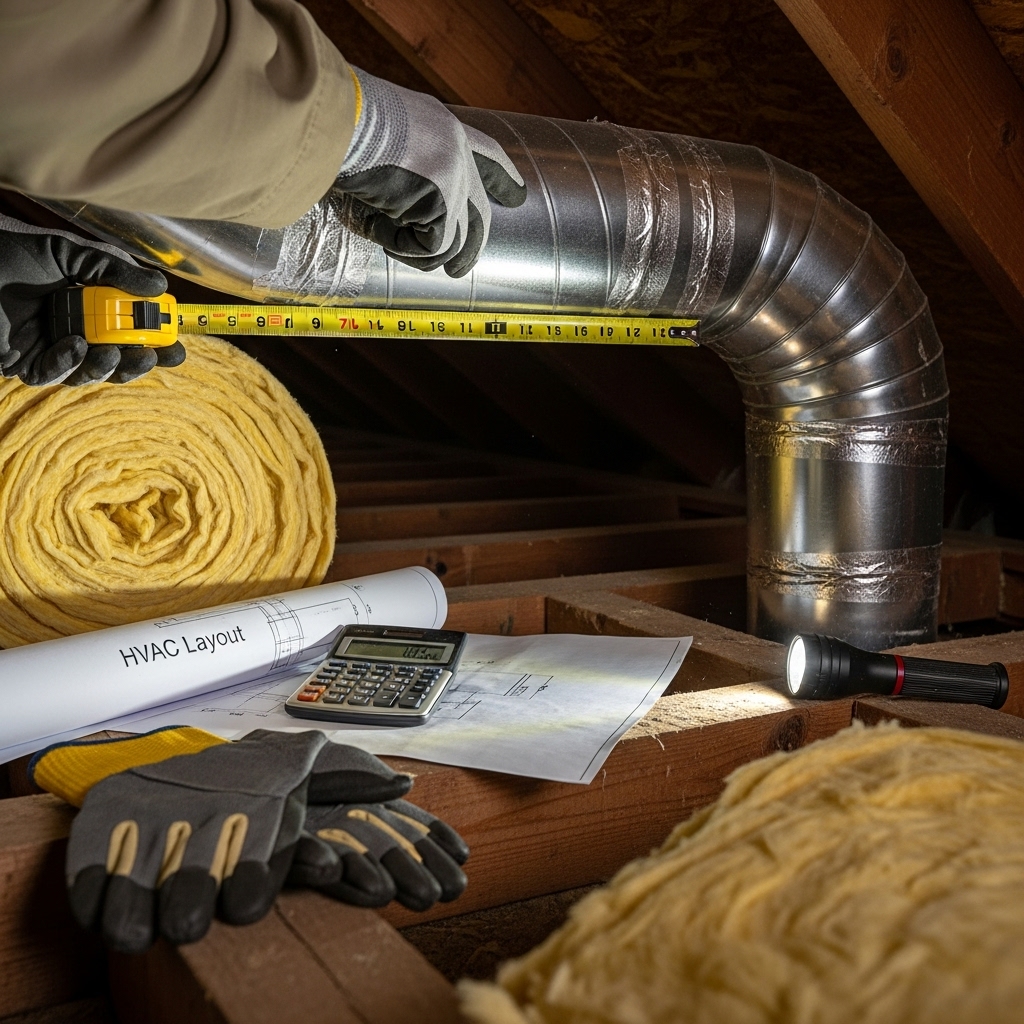
Why “Per Foot” Tells Only a Small Part of the Story
Homeowners in Malibu sometimes ask for a simple number: what’s the cost per foot for new ducts? It’s an understandable question, but per‑foot figures rarely reflect how Malibu homes actually work. Duct systems are networks, not hoses, and the value you receive comes from design, sealing, balancing, and the way materials are chosen for our coastal and canyon realities. If you’re evaluating duct replacement using only a per-foot lens, you can miss the factors that determine day-to-day comfort and long-term reliability.
Think about the path air travels in your home: it leaves the air handler, moves through a supply plenum, flows down trunks, turns through fittings, and branches into rooms before returning along a different path. Each fitting—elbows, wyes, transitions—adds equivalent length and friction that a simple tape measure can’t capture. The per-foot model overlooks that geometry and the work of sealing and supporting those components. What matters to your experience is not how many linear feet your system includes, but how well the network moves air quietly and without leaks.
Design Is the Real Driver
Malibu homes complicate simple math. Sloped roofs, tight crawlspaces, and layered remodels turn straight lines into curves and chases. A design-first approach recalculates airflow needs with Manual J and then maps trunks and branches with Manual D so static pressure stays within equipment limits. That design dictates where rigid trunks are needed, where flex can be used, and how many fittings will keep the layout compact without strangling airflow. It’s a blueprint for comfort that a per-foot number can’t express.
Returns deserve special attention. Undersized returns are a common reason for noise, dust, and poor filtration. Adding or enlarging returns doesn’t add many “feet,” but it changes everything about how your system breathes. The same goes for filter cabinets. If you want higher-MERV filtration for smoke and pollen, the return path must be able to support it. These elements shape performance far more than the length of any single run.
Materials and the Coastal Factor
Material choices respond to Malibu’s environment. Near the water, coated or stainless hardware and carefully sealed joints resist salt-laden air. Rigid trunks help maintain airflow over distance and reduce noise, while insulated flex works well for short, straight branches when properly supported. Insulation with robust vapor barriers prevents moisture problems in cool mornings followed by warm afternoons. None of these decisions show up neatly in a per-foot calculation, yet they define how the system performs and how long it lasts.
Sealing and support are part of that material story. Mechanical fastening plus mastic at every joint, taped insulation jackets, and hangers set at code spacing prevent sag and leaks. Boots sealed to building assemblies keep conditioned air from vanishing into cavities. These steps take time and skill. They’re invisible once complete, but you hear their impact in the system’s quiet operation and feel it in consistent room temperatures.
Access Changes Everything
Per-foot quotes assume uniform access. Malibu rarely provides that. Low attics, cramped crawlspaces, and tricky driveways add staging and time. Removing old ductwork without showering insulation into living areas requires containment and care. Reworking chases in older remodels takes patience and creativity. Projects with easy access might move quickly; others demand an extra day or two for safe, clean execution. The value is in doing the job once, correctly, and leaving the home as tidy as it was found—or tidier.
Multi-level homes add another layer. Vertical chases must be located and sometimes enlarged, and penetrations sealed and insulated to code. Where decks or rooflines complicate attic access, crews coordinate with roofers or carpenters. The per-foot model can’t account for those realities, but your comfort depends on how well the team navigates them.
Performance Testing: Proof Over Assumptions
California’s energy code requires performance verification on many duct projects. HERS tests confirm leakage and airflow, so the system isn’t “done” until it meets standards. Designing for those targets from the start reduces surprises. Returns must be generous enough for your chosen filter, trunks must be sized for distance and fittings, and sealing must be thorough. A per-foot number tells you nothing about whether that work will pass verification; a detailed scope with testing, balancing, and commissioning does.
Why Per-Foot Can Mislead Budget Expectations
A straight, short run of flex through a tall attic might look inexpensive on paper, but if your home needs rigid trunks to keep noise down, larger returns for better filtration, or corrosion-resistant hardware for coastal exposure, the project scope grows—without dramatically increasing linear footage. Conversely, a home with compact geometry and great access might deliver excellent results with fewer fittings and shorter runs. The point is that your investment aligns with outcomes—quiet, balanced comfort and durable materials—rather than a simplistic measure of length.
When you compare proposals, focus on narrative and drawings. Where are returns located? How are trunk sizes chosen? Which fittings are used to control turbulence? How will boots be sealed to surrounding assemblies? These details tell you how the system will feel and sound once complete. Taken together, they are a better predictor of satisfaction than any per-foot benchmark.
What a Thoughtful Malibu Scope Looks Like
It starts with a walkthrough of your home—attic headroom, crawlspace access, chases, and the rooms that give you trouble. The contractor maps existing runs, notes corrosion or damage, and listens to your goals for noise, air quality, and even aesthetics at registers. The design then right-sizes trunks and branches, plots returns for balanced intake, and chooses materials that respect the coast. During installation, old ducts are removed cleanly, penetrations sealed, new runs supported per code, and every joint is sealed. Balancing and verification follow, and the result feels like a different house—calmer and more even.
If you’re midway through the process of gathering bids, ask each contractor to explain how their design reduces static pressure, supports filtration, and limits noise. The conversation is revealing. It shows whether the team is thinking about performance or just footage. When you’ve heard that story, you’ll find that duct replacement is better evaluated by comfort and resilience than by a per-foot number alone.
Frequently Asked Questions
Is there ever a good time to use per-foot pricing?
Per-foot can be a rough screening tool for very simple, accessible runs, but Malibu’s mix of coastal exposure, tight spaces, and custom architecture quickly outgrows that model. Once fittings, returns, and verification enter the picture, linear footage becomes a small fraction of what determines outcomes. Ask for a scope that explains design and commissioning instead.
How do fittings affect performance compared to straight length?
Every elbow, wye, and transition adds equivalent length and turbulence. Two runs with the same measured length can behave very differently if one is littered with sharp turns and the other uses smooth transitions and proper radii. Good design minimizes turbulence and spreads airflow evenly, which reduces noise and lets the blower work within its comfort zone.
Why are returns so often the bottleneck?
Returns are the intake side of the system. If they’re undersized, the blower strains, filters load quickly, and noise rises. A duct project is the ideal time to right-size returns and select a filter cabinet that supports higher-MERV media for smoke and pollen. This change improves air quality and reduces stress on equipment more than adding a few feet of supply ever could.
Can I mix rigid trunks with flex branches?
Yes, and many Malibu projects do. Rigid trunks carry air farther and resist compression; flex branches handle distribution when short and straight, supported to prevent sag. This hybrid approach balances performance and practicality, especially in low attics or complex geometry where all‑rigid layouts would be intrusive or noisy.
Will per-foot quotes include sealing and testing?
Often they don’t, which is part of the problem. Sealing with mastic, proper fastening, taping insulation jackets, and commissioning with balancing and HERS verification are essential to results. If a quote treats these as afterthoughts, you may end up with a system that looks new but behaves like the old one. Insist on a scope that calls out sealing, support, and performance testing explicitly.
How much disruption should I expect in a Malibu project?
Expect careful access, protection of finishes, and daily cleanup. In beach neighborhoods with tight lots, crews plan staging to minimize impact. Inside, they establish containment at attic accesses and coordinate around your schedule. The goal is to keep living spaces functional while delivering a precise, tidy installation above the ceiling or below the floor.
Does per-foot thinking ignore air quality upgrades?
It often does. Air quality depends on return design, filtration capability, and sealing—elements not captured by a linear measure. If you’re sensitive to pollen or smoke, or if you spend long days at home, the value of a system that supports higher-MERV filters and keeps unfiltered air from creeping in is significant. Those benefits come from design decisions, not measured length.
At the end of the day, you’re buying the feel of the home: even temperatures, quiet rooms, and clean air that matches Malibu’s lifestyle. Per‑foot numbers can’t predict those outcomes, but a thoughtful plan can. If you’re ready to evaluate your options with clarity and want a design-first approach shaped by the coast and the canyons, reach out for a conversation rooted in results. Start with experienced duct replacement guidance that treats your home like the one-of-a-kind space it is, and move forward with confidence from the first sketch to the final verification.