
When the coastal breeze carries more than salt
Malibu is famous for marine layers that roll in like soft blankets and for evenings when the sky fades from gold to violet in slow motion. Yet our easy air can change quickly when regional wildfires send smoke coastward or when a damp stretch encourages musty odors to settle indoors. Over years of helping local homeowners, I’ve seen how smoke, soot, and moisture can team up to make a home feel less like a refuge and more like a reminder of recent weather and wildfire seasons. That’s where a targeted plan for air duct cleaning becomes essential. It’s not a cure-all, but it is one of the surest ways to remove residues and reset indoor air so your living room, bedrooms, and home office feel like themselves again.
Smoke and soot behave differently than ordinary dust. Their particles are incredibly fine and often oily, carrying the distinct signature of whatever burned—brush, structures, or a mix of both. They cling to surfaces inside ductwork and around coils and returns, and they carry odors that can persist for weeks or months. Add Malibu’s trademark humidity, and those residues can feel tackier and more stubborn than you’d expect. Mold concerns, meanwhile, arise wherever moisture lingers. While not every musty odor indicates active growth, the combination of dust, humidity, and organic material creates conditions where microbial life can take hold if given time and a food source. A cleaning approach that respects these differences is the key to reliable results.
How smoke and soot settle into duct systems
Wildfire smoke reaches us even when flames are miles away. Particulates drift in and find their way inside through minute openings and during windows-open living. Returns pull them into the HVAC loop, and once inside the ducts, they follow airflow, eddying at seams and turns. Because they are both fine and slightly sticky, these particles embed in the thin dust layer that already lines many ducts, deepening the reservoir and giving off a lingering smell when the system cycles on. If you’ve noticed that a faint campfire aroma haunts the living room on warm afternoons or when heating kicks in on a cool morning, you’ve met this phenomenon firsthand.
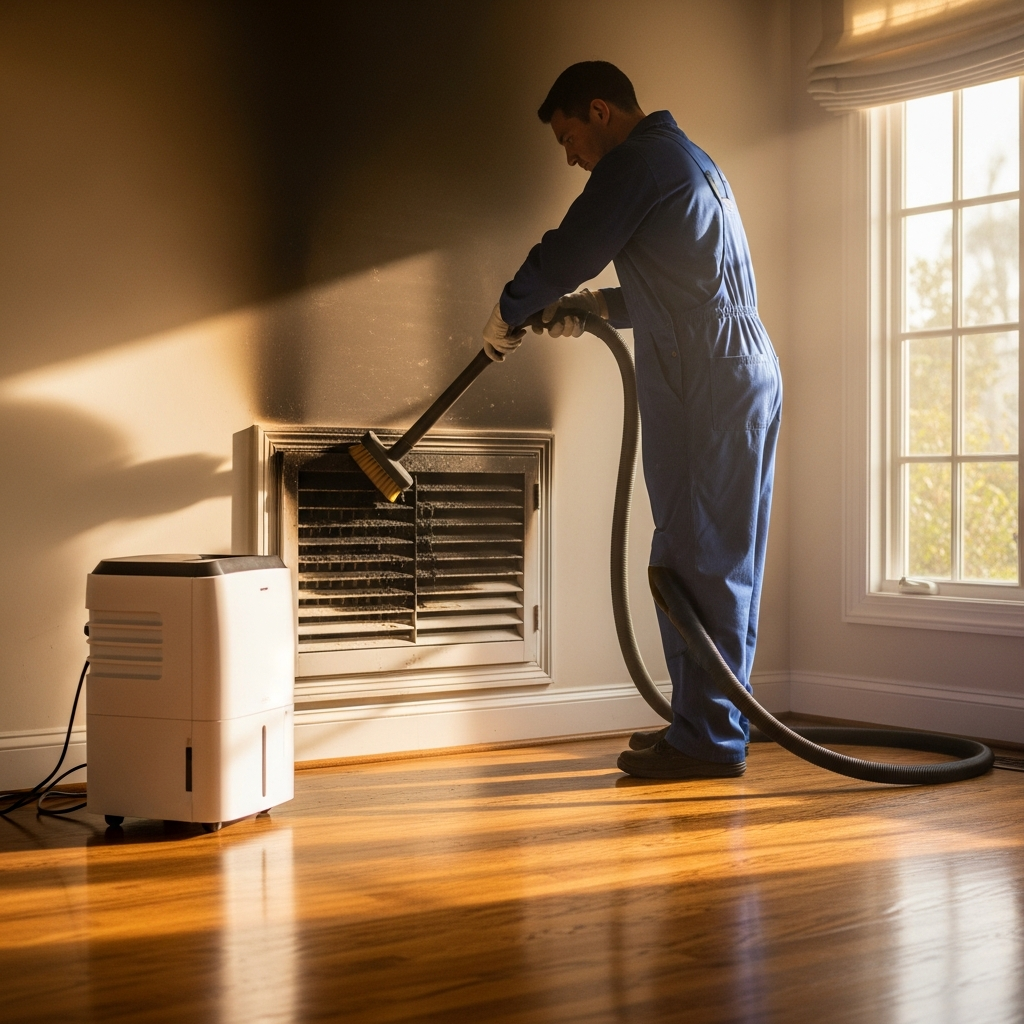
Cleaning for smoke and soot begins with a simple principle: remove the reservoir. That means creating controlled negative pressure to draw loosened material out of the system while carefully agitating surfaces so residues detach from the dust layer and travel to the collection point. Registers are sealed during agitation to prevent backflow into rooms, and the process moves section by section so material doesn’t leapfrog ahead. Because soot can smear, tools and techniques are matched to duct materials to avoid pressing residues deeper. The aim is a clean extraction path from intake to exhaust.
Mold awareness in a marine climate
Mold needs moisture, a food source, and time. Ducts themselves are not typically the primary source of moisture, but they can collect condensation under certain conditions, especially around coils and in low-airflow areas. Dust provides the organic matter mold can feed on. In Malibu’s marine layer, the gentle dampness that lingers in mornings can make those dust layers slightly sticky, and if condensation happens repeatedly, microbial life can find footholds. Cleaning removes the dust that supports growth and gives homeowners a fresh baseline to manage humidity and airflow so those footholds never form.
If there is suspected or confirmed active growth, a professional evaluation is critical to identify and correct the cause. Cleaning complements that work by removing debris that would otherwise keep odors and spores in circulation. It’s the difference between putting out the spark and clearing the tinder. In homes with past water events, a carefully staged cleaning focuses on the return side and common stagnation points so the whole loop is refreshed, not just the sections you can see.
Odor control without cover-ups
It’s tempting to mask smoky or musty smells with fragrances, but cover-ups fade while residues remain. Effective odor control in ducts is mechanical at heart—remove the material, then address contributing conditions. After cleaning, homeowners often notice a neutral quiet in the air, an absence of something that had been playing at the edge of awareness. That neutrality is a sign the reservoir is gone. Where appropriate, targeted sanitizing can support this outcome, but in occupied homes we prioritize physical removal and ventilation so indoor spaces return to their own, natural character.
Of course, the nose knows. If family members remark that rooms suddenly smell like themselves, you’ve accomplished the goal. Housekeeping tends to feel more effective as well, because the dust that used to carry odors back onto fabrics and upholstery isn’t constantly being replenished from the duct interiors.
The cleaning day: what to expect
Preparation begins with a walkthrough to pinpoint the spaces most affected by smoke, soot, or mustiness. Bedrooms and main living areas receive focused attention, and registers are protected to keep them tidy. Technicians establish access to supply trunks and returns, then set controlled negative pressure so debris flows outward. Agitation tools are selected based on duct material—metal, flex, or fiberboard—and on the type of residue present. Soot, for instance, responds best to gentle but thorough techniques that lift without smearing. The air handler area is isolated to prevent cross-contamination, and the process proceeds methodically from returns through supplies to ensure the entire loop is addressed.
Homeowners are often relieved at how contained the process is. With proper staging, neither soot nor dust migrates into living spaces. Work wraps with a careful cleanup, visual checks, and, where useful, simple measurements like static pressure or airflow at selected registers. These don’t tell the whole story, but they do confirm that the system is moving air with less effort than before, a positive sign that residues have been removed rather than rearranged.
Pairing cleaning with smarter filtration and ventilation
After a smoke or mold scare, it’s natural to think filtration must be turned up to the maximum. The trend in Malibu, however, favors right-sizing. A well-fitted filter tailored to your blower’s capabilities catches plenty without choking airflow. For homes near the beach, filter fit is as important as filter rating; air that slips around the edges carries particulates directly into the system. Combine good filtration with practical ventilation—bath fans after showers, kitchen exhaust when cooking, and a mindful approach to windows on high-smoke days—and your home stays fresher longer between cleanings.
Some residents add portable air purifiers in bedrooms during smoke season to help catch ultrafine particles at the point of breathing. These don’t replace duct cleaning, but they can provide targeted relief when outdoor conditions are acute. Think of them as spot helpers that complement a system-wide reset.
Dealing with the emotional side of smoke and mustiness
Wildfire seasons leave more than residue; they leave memories. The first warm day after a bad season can bring back worry if a faint smoke note greets you at the vent. Even a musty whiff on a foggy morning can put homeowners on edge. Cleaning, in this context, offers not just technical relief but emotional reassurance. When you know the loop is clear and the pathways are refreshed, it’s easier to trust the home again. That trust matters, especially for families with young children, older relatives, or anyone working from home who needs mental clarity alongside clean air.
Over time, as you experience season changes without the return of the old smells, confidence grows. That’s one reason I encourage homeowners to schedule cleaning as part of a recovery plan after significant smoke impact or water issues. It closes the chapter and sets you up for calm days ahead.
Midway insight: why the reset holds in Malibu
The combination of coastal humidity and intermittent smoke exposure makes Malibu homes uniquely sensitive to residues. That’s why the structured reset of professional air duct cleaning is so effective here. By physically removing the material where it hides—at seams, bends, and returns—you lower the background load dramatically. Then, with routine habits and right-sized filtration, you keep the system from rebuilding the same reservoirs. The ocean will do what it does. A clean system lets you enjoy the breeze without letting past smoke or stale dampness define the air inside.
Frequently asked questions about smoke, soot, and mold in ducts
Q: Will duct cleaning remove all smoke odor? A: It often removes the majority by clearing residues that emit the smell. In cases with severe smoke intrusion, additional steps—like cleaning soft furnishings and addressing attic or wall cavities—may be needed to eliminate every trace.
Q: How soon after a smoke event should I schedule service? A: As soon as outdoor air quality improves and the home is secure. Prompt cleaning helps prevent deeper embedding of residues and speeds your return to normal.
Q: Can mold grow inside ducts? A: It can occur where moisture and organic dust meet, especially near coils or in low-airflow sections. Cleaning removes the dust component and creates a better starting point for humidity control that prevents recurrence.
Q: Do I need antimicrobial treatments? A: Not always. Many homes achieve excellent results with source removal alone. Where treatments are appropriate, they should be targeted, used judiciously, and paired with moisture management to address causes rather than symptoms.
Q: Is the process safe for households with children or pets? A: Yes. Professional crews isolate work areas, maintain negative pressure, and use containment to keep dislodged material from entering living spaces. The result is a cleaner system without disrupting the daily rhythm of the household.
Q: How can I prevent odors from returning? A: Keep filters well-fitted and on schedule, manage humidity, ventilate during cooking and showers, and close windows during heavy smoke days. These simple steps sustain the benefits of a thorough cleaning.
Return your Malibu home to its easygoing self
Your home should smell like itself—salt air at the threshold, perhaps a favorite candle in the evening, but never a lingering echo of last season’s smoke or a damp reminder of a foggy week. If those notes have crept into your days, consider a reset that addresses the problem where it lives. Start with trusted Malibu air duct cleaning, and pair it with smart habits that keep the gains. The ocean will always write part of our story; make sure your home’s chapter reads clean, clear, and calm.