
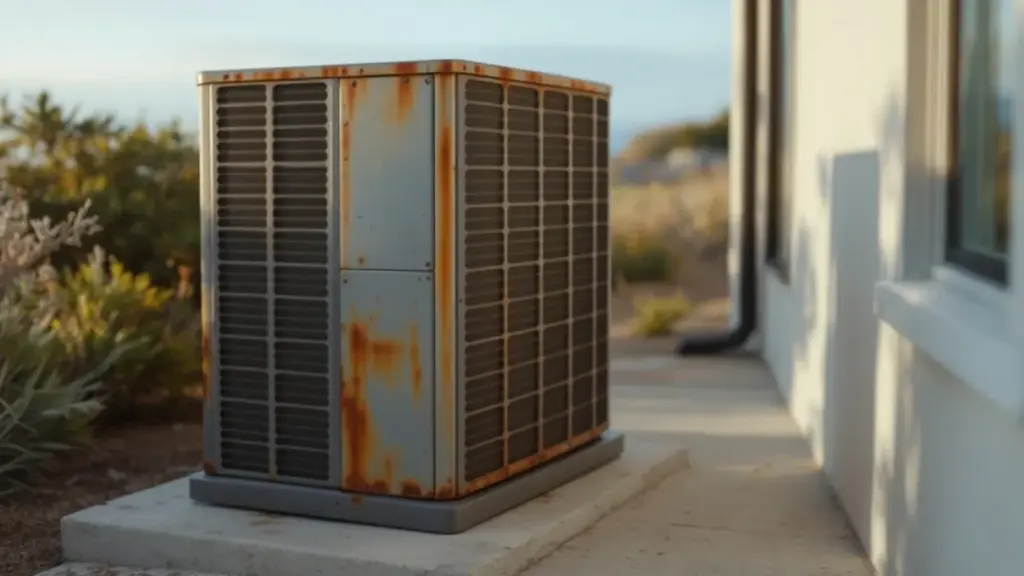
7 Signs Your Malibu Coast HVAC System Has Rust Damage
How do you know when salt air has moved from nuisance to real damage inside your heating and cooling system? The short answer: your equipment will show you, if you know where to look. For homeowners along the Malibu coastline, where marine layer and onshore breezes push salt particles inland year-round, catching corrosion early can mean the difference between a simple service call and a full system replacement. Here are seven concrete warning signs to watch for.
1. Visible Orange or Brown Streaks on the Outdoor Unit
The condenser cabinet sitting outside your home is the first line of exposure. When salt-laden air settles on bare metal panels and fasteners, oxidation begins within months rather than years. Look for orange or reddish-brown streaking along seams, around screw heads, and at the base of the unit where moisture pools. Light surface rust on a cabinet panel is cosmetic; rust that has eaten through to the coil fins or refrigerant lines underneath is a structural concern. Either way, streaking is your earliest visible cue that the coastal environment is actively working on your equipment. If you notice this, it is worth scheduling an inspection before the corrosion migrates inward. For a broader look at what salt air does to cooling equipment over time, see how salt air damages Malibu air conditioners.
2. Corroded or Pitted Coil Fins
Aluminum condenser and evaporator fins are thin by design, which makes them efficient at heat transfer and vulnerable to formicary corrosion, a type of pitting caused by the interaction of moisture, organic acids, and chlorides in coastal air. Run a gloved finger lightly along the fin rows of your outdoor unit. Healthy fins feel sharp and uniform. Fins that crumble, feel gritty, or show small pinholes have begun to pit. Pitted fins restrict airflow, reduce heat-exchange efficiency, and can eventually develop refrigerant leaks. This is one of the more technically serious signs on this list because coil damage directly affects system performance and can be expensive to address once it progresses beyond surface treatment.
3. Refrigerant Line Rust at the Connection Points
If you want it handled correctly the first time, consider professional heating cooling in Malibu.
The copper refrigerant lines that run between your outdoor condenser and indoor air handler are generally corrosion-resistant, but the steel fittings, brackets, and clamps that secure them are not. In Malibu’s salt-heavy air, these connection points often rust before the copper itself shows any wear. Check where the lines enter the wall of your home and where they attach to the outdoor unit. Rust at these joints can indicate that moisture is wicking into the connection, which raises the risk of refrigerant leaks over time. A technician can apply protective coatings or replace compromised fittings during a routine service visit, which is far less disruptive than chasing a slow refrigerant leak later.
4. Malibu’s Marine Layer: Why Corrosion Accelerates Here
This sign is less about what you see and more about understanding why Malibu homes face a faster corrosion timeline than inland properties. The Malibu coastline sits directly in the path of persistent marine layer, a low-lying fog that rolls in from the Pacific and deposits fine salt aerosols on every outdoor surface. Homes within roughly a mile of the waterline, including much of the Pacific Coast Highway corridor and canyon-mouth neighborhoods like Las Virgenes, experience salt deposition rates that can be several times higher than properties just a few miles east in the San Fernando Valley. That accelerated exposure means outdoor HVAC components rated for a standard service life may show significant corrosion in a fraction of that time. Seasonal Santa Ana winds add a secondary stress: they draw moisture out of materials rapidly, creating expansion-and-contraction cycles that open micro-cracks in protective coatings and invite salt deeper into metal surfaces. If your system is more than five years old and has never had a corrosion-specific inspection, the marine layer alone is reason enough to schedule one. Our Malibu HVAC service guide covers the full picture of how coastal conditions affect system longevity.
5. Rust Stains or Discoloration Around the Air Handler
The indoor air handler is more protected than the outdoor unit, but it is not immune. Check the sheet-metal cabinet of your air handler, particularly around drain pan connections, refrigerant line entry points, and any area where condensation regularly forms. Rust staining on the cabinet exterior, or orange-tinged water marks on the wall or ceiling nearby, suggests that internal components, often the drain pan or evaporator coil housing, have begun to corrode. A rusted drain pan is a practical problem: it can crack and allow water to overflow, leading to water damage in addition to the HVAC issue itself. Discoloration inside supply or return vents can also point to rust particles circulating through the duct system, which is worth investigating separately.
Many Malibu homeowners rely on expert heating cooling in Malibu for exactly this.
6. Unusual Noises During Operation
Corrosion does not stay on the surface. As rust progresses on fan blades, motor housings, and blower wheels, it creates imbalances and rough edges that produce sounds the system would not normally make. A rattling or scraping noise from the outdoor unit during startup often means a fan blade has developed surface rust or a corroded mounting bracket has loosened. A grinding noise from the air handler can indicate a blower wheel with rust buildup that is now out of balance. These sounds are easy to dismiss as minor, but they typically signal that a component is under mechanical stress it was not designed to handle. Catching the source early, before a blade or bearing fails completely, usually means a much simpler repair. If you are hearing new noises and your system is located near the coast, corrosion is a logical first suspect.
7. Higher Energy Bills Without a Clear Cause
When corrosion degrades coil fins, clogs heat-exchange surfaces with rust scale, or causes a fan motor to work harder against friction, the system has to run longer cycles to reach the same temperature setpoints. That extra runtime shows up on your energy bill before it shows up as a visible failure. If your cooling or heating costs have crept upward over one or two seasons without a change in your usage habits, and your system is more than a few years old in a coastal Malibu location, reduced efficiency from corrosion-related wear is a plausible cause. A technician performing a coastal HVAC inspection can measure system performance metrics, airflow, refrigerant charge, and motor amp draw, to identify whether degradation is the culprit. Addressing the underlying corrosion often restores efficiency closer to original specifications. For guidance on finding a technician experienced with salt-air systems specifically, choosing the right coastal HVAC contractor in Malibu walks through what to look for.
Ready for the next step? Learn how heating cooling services in Malibu can help and reach out to the team.
Frequently Asked Questions
How quickly does salt air cause visible rust on an HVAC system in Malibu?
The timeline depends on how close the property is to the water and whether the equipment has any factory-applied protective coatings. Units within a few blocks of the Pacific Coast Highway waterfront can show surface oxidation within one to two years of installation without additional protection. Properties further inland, toward the canyon communities, typically see a slower progression, but marine layer exposure still accelerates corrosion compared to non-coastal climates.
Can I clean surface rust off my outdoor unit myself?
Light surface rust on painted cabinet panels can sometimes be addressed with a rust-inhibiting primer and exterior paint rated for marine environments, but this is cosmetic only. Rust on coil fins, refrigerant fittings, or electrical components should be evaluated by a licensed technician before any cleaning or treatment is attempted, since improper handling can damage delicate fins or disturb refrigerant connections. Our article on safely washing salt off outdoor HVAC units covers what homeowners can reasonably do themselves.
Does corrosion void my HVAC equipment warranty?
Warranty terms vary by manufacturer, and some explicitly exclude corrosion damage in coastal environments unless the buyer purchases a coastal or marine-grade protection package at the time of installation. Review your documentation carefully and consult a licensed HVAC professional if you are unsure whether damage you are seeing falls within or outside your coverage. Requirements and interpretations vary, so a professional assessment gives you the documentation you may need for any warranty conversation.
Catching these signs early keeps repair costs manageable and extends the working life of your system. If any of the seven warning signs above look familiar, the next step is a professional inspection by a technician who understands Malibu’s specific coastal conditions. Reach out to Smart HVAC System to schedule a corrosion assessment, and get ahead of any damage before the next marine layer season sets in.