
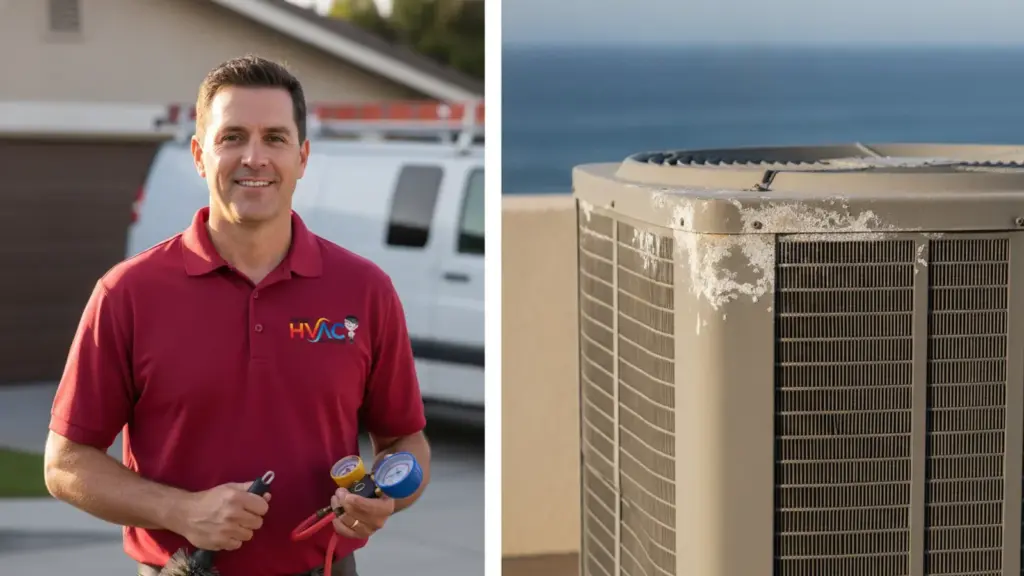
Why Salt Air Ruins Malibu Air Conditioners (And What You Can Do About It)
Copper corrodes up to ten times faster in marine environments than in dry inland air. For Malibu homeowners, that statistic is not abstract: every outdoor condenser unit within a mile or two of the Pacific is bathed daily in salt-laden mist that quietly eats through metal, clogs coil fins, and shortens equipment life. Understanding the process is the first step toward stopping it.
What exactly is salt air, and why is it so corrosive?
Sea spray and ocean wind carry microscopic chloride particles that stay suspended in the air long after the water droplets evaporate. When those particles land on metal surfaces, they attract moisture from the surrounding humidity and form a thin electrolytic film. That film acts like a battery, driving an electrochemical reaction that oxidizes aluminum fins, copper tubing, and steel fasteners continuously. Malibu’s coastal climate means this process rarely gets a break: even on clear days, the marine layer pushes chloride-rich air inland through the canyons and across the bluffs, keeping condenser surfaces in near-constant contact with a corrosive environment.
Which parts of an air conditioner are most vulnerable to salt damage?
The outdoor condenser unit takes the hardest hit because it sits exposed to the elements year-round. Within that unit, the aluminum condenser coil fins are particularly susceptible because they are thin, densely packed, and designed to maximize surface area, which also maximizes chloride contact. Copper refrigerant lines develop pitting corrosion that can eventually cause slow refrigerant leaks. Steel cabinet panels and fasteners rust from the outside in, and the electrical contacts inside the contactor and capacitor can oxidize to the point where the unit struggles to start. Even the copper wiring insulation can degrade faster in a high-humidity, high-chloride environment. Indoor air handlers are somewhat protected, but if the home draws in outside air through a fresh-air intake, corrosive particles can reach the indoor coil over time as well.
How does Malibu’s specific geography make corrosion worse than other coastal towns?
If you want it handled correctly the first time, consider professional heating cooling in Malibu.
Malibu stretches roughly 21 miles along a narrow coastal shelf with the Santa Monica Mountains rising sharply behind it. That topography creates a natural funnel: onshore winds carry salt air directly into hillside neighborhoods with little buffer from vegetation or distance. Properties in the Malibu Colony, Point Dume, and Carbon Beach areas sit close enough to the surf line that spray mist is a daily reality. Even homes several miles inland along Malibu Canyon Road experience the marine layer most mornings. Unlike a city set back from the coast by flat miles of development, virtually every Malibu property sits within what HVAC engineers classify as a severe marine corrosion zone. Equipment rated for standard residential use was not designed with that environment in mind, which is why coastal HVAC maintenance specific to this area matters so much more here than in an inland suburb.
How quickly does salt air actually degrade an outdoor condenser coil?
The rate depends on proximity to the water, prevailing wind direction, and how consistently the unit is maintained. A condenser coil that would last fifteen or more years in a dry inland climate can show significant fin corrosion within three to five years in a severe marine environment without protective treatment. The degradation is not always visible from the outside: fins may look intact while the base metal has thinned enough that airflow is restricted and heat transfer efficiency has dropped noticeably. Homeowners often first notice the problem as higher electricity bills or a system that runs longer than it used to before reaching the set temperature. By the time white or gray oxidation is clearly visible on the fins, the corrosion is already well established. Catching it earlier, through regular professional inspections, is the practical way to extend coil life. Our article on recognizing early warning signs covers the symptoms worth watching between service visits.
Does salt air damage the refrigerant lines and electrical components too?
Yes, and those failures can be more immediately disruptive than coil corrosion. Copper refrigerant lines develop pitting, which is a form of localized corrosion that creates small holes rather than broad surface oxidation. A pinhole leak in a refrigerant line causes the system to lose charge gradually, reducing cooling capacity and forcing the compressor to work harder. Left unaddressed, low refrigerant stresses the compressor to the point of failure, and compressor replacement is one of the more significant repairs an HVAC system can require. On the electrical side, the contactor, which is the high-voltage switch that starts the compressor, has copper contacts that oxidize in salt air. Oxidized contacts create resistance, generate heat, and eventually weld together or fail to close, leaving the system unable to cool. Capacitors, which store the electrical charge needed to start motors, can also degrade faster in humid, corrosive conditions.
Many Malibu homeowners rely on expert heating cooling in Malibu for exactly this.
Can homeowners do anything themselves to slow salt air corrosion?
A few safe, practical steps can make a real difference between professional service visits. Rinsing the outdoor condenser coil with a gentle garden hose spray (not a pressure washer) every month or so removes accumulated salt deposits before they have time to pit the fins. Always turn the system off at the thermostat and breaker before rinsing, and let the unit dry before restarting. Keeping vegetation trimmed back from the unit improves airflow and reduces the moisture that salt particles need to drive corrosion. Checking that the cabinet drain holes are clear prevents pooled water from sitting against the base pan. What homeowners should not do is apply random rust-inhibiting sprays to coil fins without knowing whether the product is rated for HVAC use, as some coatings reduce heat transfer and can void equipment warranties. For protective coil coatings and electrical contact treatment, see our guide on HVAC rust prevention in Malibu for a closer look at what professional-grade protection involves.
What does professional corrosion protection for a Malibu AC unit actually involve?
A qualified technician working in a coastal environment goes well beyond a standard tune-up checklist. Coil cleaning in a marine environment uses a pH-neutral, non-acid coil cleaner that removes salt and organic debris without further attacking the aluminum fins. After cleaning, a corrosion-inhibiting coil coating, typically a phenolic or epoxy-based product rated for marine exposure, is applied to the condenser coil to create a barrier between the metal and the chloride-laden air. Electrical connections are cleaned, treated with a dielectric compound, and re-torqued. The contactor and capacitor are inspected and replaced if oxidation has compromised their function. Refrigerant lines are checked for pitting and any insulation that has degraded is replaced. This level of service is meaningfully different from a basic filter change and refrigerant top-off, and it is the kind of work described in detail on the full coastal HVAC maintenance guide for Malibu properties.
Ready for the next step? Learn how heating cooling services in Malibu can help and reach out to the team.
Are there equipment choices that hold up better in Malibu’s marine environment?
When replacing aging equipment, the specification choices matter significantly for longevity near the coast. Condenser coils made with spine-fin or microchannel aluminum designs have fewer crevices where salt can accumulate compared to traditional slab coils. Some manufacturers offer factory-applied corrosion-resistant coatings on condenser coils specifically for coastal installations. Stainless steel or polymer drain pans resist rust better than galvanized steel. For refrigerant lines, ensuring that any new copper lines are properly insulated and that insulation is sealed at both ends reduces moisture infiltration. Asking specifically about coastal or marine-rated components when getting a replacement quote is worth the conversation. Our page on selecting the right HVAC contractor for coastal Malibu walks through the questions to ask before committing to an installation.
How often should a Malibu homeowner schedule professional HVAC service?
The standard industry recommendation of one maintenance visit per year is a floor, not a ceiling, for properties in Malibu’s corrosion zone. Most HVAC professionals working regularly in coastal Southern California recommend two visits per year for homes within a mile of the water: one in spring before the cooling season begins and one in fall after heavy use. Homes directly on the beach, or those in exposed locations like Point Dume or the Colony, may benefit from quarterly coil rinses by a technician during the summer months when the combination of heat, humidity, and heavy system use accelerates corrosion. The cost of an additional service visit is a fraction of the cost of replacing a compressor or a condenser coil, so the frequency pays for itself in extended equipment life and avoided emergency calls.
Salt air corrosion is a predictable challenge for any Malibu home with an outdoor HVAC unit, but it is not an inevitable one. Regular rinsing, professional coil treatment, and attentive inspection of electrical components can keep a well-maintained system running reliably for its full expected service life even a block from the Pacific. If your condenser unit has not had a coastal-specific service in the past year, or if you have noticed any of the early warning signs covered in our article on coastal HVAC repair signals, reaching out to a technician familiar with Malibu’s marine environment is the practical next step. Smart HVAC System serves Malibu and the surrounding coastal communities and is ready to help you protect your investment. Contact us to schedule a coastal corrosion inspection or a full seasonal maintenance visit.