
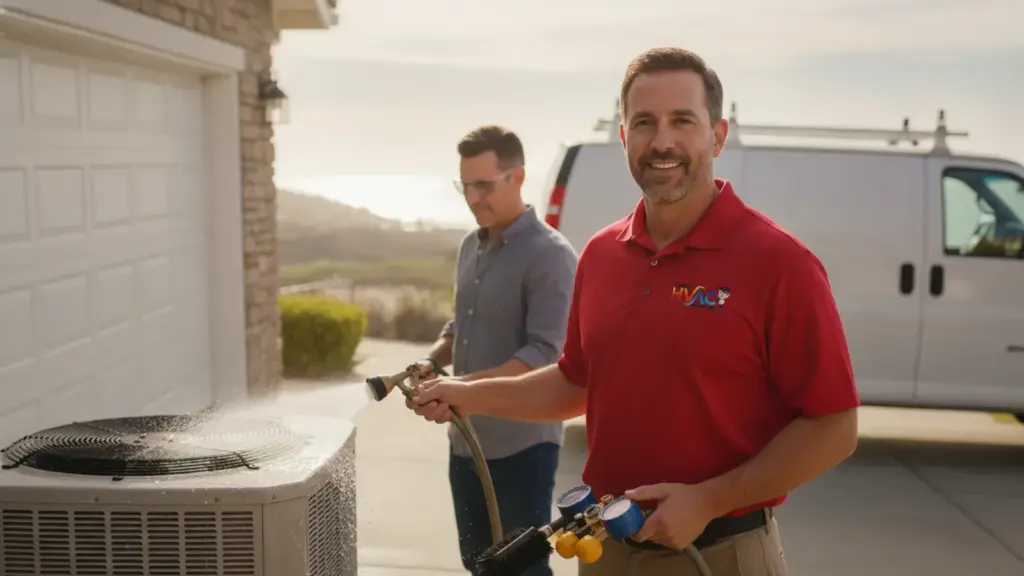
How to Safely Wash Salt Off Your Outdoor AC Unit in Malibu
That faint white crust you noticed on your condenser fins last Saturday morning, the one that looks a little like dried sea spray, is exactly what it is. Malibu’s salt-laden marine air deposits sodium chloride on outdoor HVAC equipment every single day, and letting it sit accelerates corrosion faster than most homeowners expect. This checklist walks you through a safe, effective rinse protocol so you can slow that process between professional service visits.
Before You Start: Safety and Prep Checklist
- Turn the thermostat to OFF at the wall before approaching the outdoor unit.
- Cut power at the dedicated disconnect box mounted near the condenser (the metal box on the wall beside the unit).
- Wait at least five minutes after shutting down before touching any part of the unit, capacitors hold a charge.
- Put on safety glasses; dislodged debris and water can flick toward your face when you rinse.
- Check the forecast: rinse on a mild, overcast day when temperatures are between roughly 50°F and 85°F so the unit does not restart into wet coils unexpectedly.
- Gather your supplies before you begin: a standard garden hose with an adjustable nozzle, a soft-bristle brush (a clean paintbrush or fin comb works well), and a bucket of plain water.
- Never use a pressure washer. The aluminum fins inside a condenser coil bend permanently under high-pressure spray, restricting airflow and reducing efficiency.
- Skip household cleaning chemicals, bleach, or acidic degreasers unless a licensed technician has specifically recommended a coil-safe product for your unit model.
Inspecting the Unit Before You Rinse
- Walk a slow circle around the condenser and note any visible rust streaks on the cabinet, corroded screws, or fins that are already bent or matted together.
- Look at the copper refrigerant lines where they enter the unit: greenish or white oxidation at the fittings is a sign of accelerating corrosion that goes beyond what a rinse can address.
- Check that the concrete pad or mounting surface is still level; coastal soil erosion near the bluffs can shift pads over time.
- Confirm the disconnect box cover closes fully and shows no rust inside the panel, water intrusion there is an electrical concern for a licensed technician, not a DIY fix.
- If you spot refrigerant oil staining (a dark, oily residue on the lines or around fittings), stop and schedule a professional inspection before running the system again. Refrigerant work requires EPA certification and is not a homeowner task.
- Note how thick the salt crust is. A light haze rinses easily. Heavy, chalky buildup that has been there for months may need a coil cleaner applied by a pro. See how salt air damages Malibu AC systems for a deeper look at what prolonged exposure does to coil material.
If you want it handled correctly the first time, consider professional heating cooling in Malibu.
The Rinse: Step-by-Step Checklist
- Start at the top of the unit and work downward so loosened deposits flow away from surfaces you have already cleaned.
- Set your hose nozzle to a gentle, wide-fan spray (similar to a shower setting). You want volume, not velocity.
- Rinse the exterior cabinet panels first to knock off surface salt before water reaches the fins.
- Direct the spray through the fins from the inside out when possible. On most residential condensers, you can aim the nozzle through the top grille downward and inward so water pushes debris outward rather than deeper into the coil.
- Work in slow, overlapping passes. Do not hold the nozzle in one spot; keep it moving to avoid concentrating pressure.
- Use the soft-bristle brush only on the exterior cabinet and the top grille, never directly on the fins themselves. Brushing fins bends them.
- Rinse the refrigerant line insulation and the area around the service valve caps; salt collects in those crevices.
- Flush the base pan inside the unit (visible through the grille) to clear any standing water, debris, or salt residue that has dripped down.
- Do a final slow rinse of the full exterior from top to bottom.
- Allow the unit to air-dry for at least 15 minutes before restoring power.
After the Rinse: Restore Power Safely
- Visually confirm no water is pooled on top of the unit or dripping into the disconnect box before you restore power.
- Replace the disconnect box cover fully before flipping the breaker or reinserting the pull-out fuse block.
- Restore power at the disconnect first, then set the thermostat back to your desired mode.
- Let the system run for five minutes and listen for any new rattles, grinding, or unusual sounds that were not present before the rinse. If you hear something new, turn the unit off and call a technician.
- Check that the airflow coming from the top of the condenser feels strong and unobstructed; weak discharge airflow after a rinse can mean debris has shifted into the fan blade area.
- Log the date of the rinse. Malibu homeowners within a quarter mile of the waterline benefit from rinsing every four to six weeks during summer; those further inland on the canyon roads can often extend that to every eight weeks.
Malibu-Specific Considerations for Coastal Outdoor Units
Many Malibu homeowners rely on expert heating cooling in Malibu for exactly this.
- Marine layer timing matters. The June Gloom and late-summer marine layer that rolls in off Point Dume and Malibu Lagoon keeps humidity elevated for long stretches, which means salt deposits absorb moisture and stay chemically active on metal surfaces longer than in drier climates. Rinsing after a heavy marine layer event, not just after visible surf spray, is worth adding to your routine.
- Canyon locations are not exempt. Properties in Malibu Canyon, Topanga, and the Santa Monica Mountains foothills still receive salt aerosols carried inland by onshore winds, particularly during the late-afternoon sea breeze. The concentration is lower than beachfront, but corrosion still occurs.
- Wildfire ash compounds the problem. After fire events in the Santa Monica Mountains, ash settles on outdoor units and mixes with salt residue to form a mildly acidic paste. Rinse promptly after any ash fall, and check the air filter indoors as well.
- Building setbacks and HOA rules. Some Malibu Coastal Zone properties have landscaping and equipment placement rules under the California Coastal Commission’s local coastal programs. If your unit is on a deck or close to a bluff edge, confirm that your rinse water runoff complies with any site-specific conditions of approval. Requirements vary by parcel; check with your local planning contact if you are unsure.
- Aluminum vs. copper fins. Older Malibu homes built in the 1970s and 1980s sometimes have condensers with all-copper coils, which corrode differently than modern aluminum fin/copper tube designs. If your unit predates the mid-1990s, ask a technician whether a protective coil coating is appropriate before you establish a rinse schedule.
- Post-rinse corrosion inhibitor. Some homeowners in the beachfront zones of Carbon Beach and La Costa apply a light spray of a coil-safe corrosion inhibitor after rinsing. This is a reasonable step, but choose a product rated for HVAC coils and confirm compatibility with your unit’s manufacturer guidelines. A technician can apply a professional-grade coating during a scheduled tune-up. For details on protective treatments, see rust prevention strategies for Malibu HVAC equipment.
When a Rinse Is Not Enough
- If the fins are more than 20 percent blocked (you cannot see light through them when you look at an angle), a chemical coil cleaning by a licensed technician is the appropriate next step, not more water pressure.
- Visible rust on the cabinet that has penetrated through the paint and is lifting in flakes signals that the unit’s protective coating has failed. A technician can assess whether a cabinet coating or unit replacement is the better path.
- Any sign of refrigerant leakage (oily residue, ice on the lines, weak cooling despite a clean coil) requires a certified HVAC technician. Refrigerant handling is regulated and is not a homeowner task.
- Electrical components inside the unit, including the contactor, capacitor, and wiring, should only be inspected and serviced by a licensed professional.
- If the unit is more than ten years old and showing significant corrosion, a professional assessment of remaining service life is a worthwhile conversation to have before investing in repairs. The air conditioning maintenance Malibu guide covers what a full professional tune-up includes and how often coastal homeowners should schedule one.
- Bent fins covering a large area of the coil face need a fin comb straightened by a technician, not a DIY attempt. Improper straightening can puncture the refrigerant tubing behind the fins.
- If you notice any of the warning signs described in signs your coastal HVAC system needs repair, schedule a service call rather than continuing to rinse and wait.
Frequently Asked Questions
Ready for the next step? Learn how heating cooling services in Malibu can help and reach out to the team.
How often should Malibu homeowners rinse their outdoor AC unit?
Beachfront properties within a few hundred feet of the waterline benefit most from rinsing every four to six weeks during the cooling season, and at least once in winter. Homes further inland, including canyon properties, can typically extend that interval to every six to eight weeks. After any significant storm, ash event, or prolonged marine layer period, an extra rinse is worthwhile regardless of your regular schedule.
Can I use dish soap or household cleaner to help dissolve the salt?
Plain water handles light salt deposits well, and most household cleaners are not formulated for HVAC coil materials. Surfactants and acids in common cleaners can degrade the aluminum fins or leave residue that attracts more particulates. If a simple rinse is not removing stubborn buildup, ask a licensed technician about a coil-safe cleaner designed specifically for HVAC equipment.
Will rinsing the unit void my warranty?
A gentle water rinse with a garden hose is a standard maintenance task that most manufacturers describe in their care guides and does not void warranties on its own. What can affect warranty coverage is using high-pressure water, unauthorized chemical cleaners, or opening the unit’s panels without proper credentials. When in doubt, review your unit’s documentation or ask your HVAC technician during the next scheduled visit.
A consistent rinse routine is one of the simplest things a Malibu homeowner can do to slow salt corrosion on outdoor HVAC equipment. It takes under thirty minutes, costs nothing beyond tap water, and meaningfully extends the intervals between costly repairs. Pair it with the twice-yearly professional tune-ups covered in our air conditioning maintenance Malibu guide, and your system has a much better chance of handling the coastal environment for its full service life. If your inspection turns up anything beyond surface salt, our team at Smart HVAC System is ready to help.